Last September, I finally shot even par for the first time. I even had a plaque made to commemorate it. I started playing golf in 2004, so it had taken me 21 years. By any reasonable standard, this was not rapid progress.
I do not think of myself as completely lacking athletic ability, but golf made me work very hard for a very long time. After that even-par round, I thought I had achieved nearly everything I wanted from the game, apart from a hole-in-one. I had even made an albatross once. Then the usual human problem appeared: once you sit down, you want to lie down; once you lie down, you want to sleep. Even par was no longer enough. Perhaps I should try to shoot under par.
In July, I did it for the first time, barely: one under. Fewer than ten days later, I did it again. Could I now claim that I had become a good enough golfer to shoot under par regularly? Looking back at the two scorecards, and thinking about the rounds I played afterward, my honest answer is no. A great many things happened to line up. I still have a long way to go before an under-par round feels less daunting.
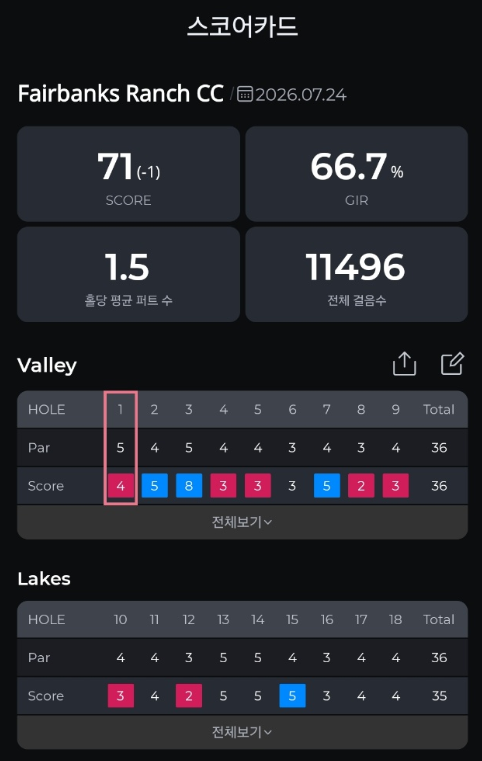
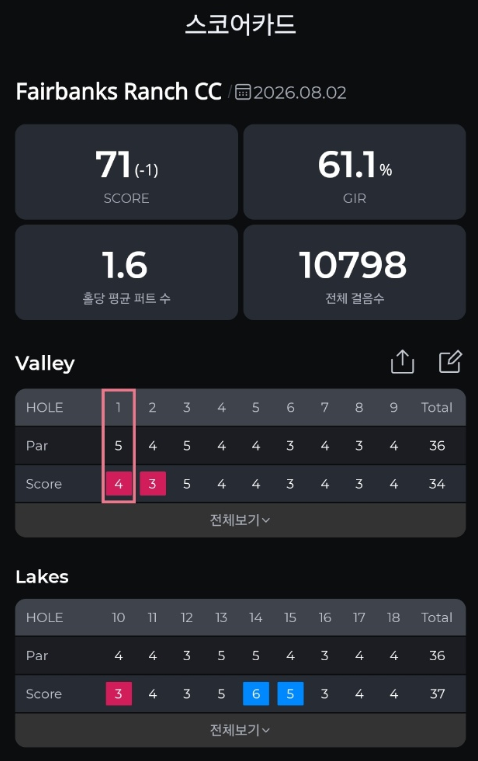
Both rounds were at Fairbanks Ranch Country Club. I played the Valley and Lakes nines on July 24 and August 2, and shot 71 each time. The final numbers matched, but the scorecards told two completely different stories. One was a roller coaster. The other was a cruise ship.
Method One: Make Enough Birdies
The July 24 round began pleasantly enough with a birdie on the par-five first. Then I made bogey on the second. On the next par five, the third hole, I hit a tree with my tee shot, another tree with my second shot, and a third tree with my third shot. Three consecutive tree contacts produced a triple bogey. After three holes I was already three over, and I assumed this was simply going to be another ordinary bad day.
Then I birdied the difficult fourth and fifth holes on the Valley nine. I gave one back at the seventh, then made birdies at eight and nine to finish the front nine at even par. The card contained five birdies, two bogeys, and one triple in only nine holes. I had made four birdies in a round several times, but I could not remember whether I had ever made five. At that point I decided that, whatever happened to the score, I was going to set a personal record for birdies.
I birdied the first hole on the Lakes nine, then added another at the twelfth. My playing partners said they had almost never seen an amateur make seven birdies in one round, and they began cheering for an eighth. It never came. Instead, I bogeyed the fifteenth and played the back nine in one under.
Seven birdies in one round is something an amateur can reasonably brag about. Unfortunately, after those seven birdies paid off one triple bogey and three regular bogeys, only one under remained in the account. One of my playing partners laughed and said that seven birdies ought to produce a score of three or four under. He had a point.
This is the first way an amateur can break par. We make plenty of mistakes, so we simply need to make more birdies. Easy. It is about as useful as telling someone who spends too much money that the solution is to earn a larger salary. It resembles the attack-first style I associate with Sung Hyun Park. I am less certain about the odds of making it work regularly.
Method Two: Stop Giving Shots Away
The August 2 round felt entirely different, even though I played the same two nines. I began with birdies on the par-five first and the relatively friendly second. I thought something interesting might be happening again. Then I made par on every hole through the ninth.
I birdied the tenth, the first hole on the Lakes nine, and reached three under. Naturally, I began imagining that I was about to improve a personal record I had set only days earlier. Somehow I managed not to become too excited. I played calmly, made bogeys at fourteen and fifteen, and parred everything else. The result was another 71: three birdies, two bogeys, and no double or triple bogeys.
The July scorecard is noisy with color. Birdie, bogey, triple bogey, then more birdies. The August card is mostly quiet. Pars line up, interrupted only occasionally by a birdie or bogey. If July was an action movie, August was a low-key Japanese drama. There were fewer spectacular scenes, but it was much easier on the nerves.
The best golfers I play with tend to produce cards like the August one. They make par after par and occasionally add a birdie. It can look rather boring. Their scores are also remarkably stable.
Interestingly, the more chaotic July round had the better greens-in-regulation number: 66.7 percent compared with 61.1 percent in August. It also had slightly fewer putts per hole, 1.5 versus 1.6. Seven birdies usually require hitting greens in regulation and putting well. Golf would be a wonderfully easy game if I could simply do that all the time.
The Method I Would Choose
After these two rounds, I came away believing that avoiding large mistakes matters more than collecting birdies. Take the birdie chances when they appear. On the other holes, accept par. The tee shot should stay in play. If a shot finishes in trouble, hit it near the green or escape to a place from which the next shot can reach the green. If the approach misses, leave a realistic par putt. If none of that works, make bogey. Do not make double. Do not even imagine triple.
Both rounds were fun. Seven birdies may be a personal record I never break, and shooting under par after a triple bogey remained good material for post-round beers. But the August round taught me more about what good golf looks like. It lacked the drama of July, yet it was closer to the basic nature of the game: reduce mistakes, keep making pars, and let a birdie appear when fortune offers one.
Now that I have broken par twice, the only thing left on my original golf wish list is a hole-in-one. Of course I would be happy to keep lowering my lifetime-best score, and one day it would be nice to shoot my age. But those would be gifts. If they never happen, I do not think I will have much cause for complaint.
This column was adapted from my original Korean article on Naver Blog.