Here, mid-range means roughly 8–20 feet: putts worth trying to hole while keeping the next stroke manageable.
A low miss does not identify the cause
Low side means the downhill side of a breaking putt. On a right-to-left putt, it is left; on a left-to-right putt it is right. Missing low on both breaks suggests investigating reading and pace. Missing physically left on both also warrants checking the starting direction. Neither pattern is a diagnosis.
Read and pace are a pair. On a simple side slope, a slower roll generally curves more over the same distance. A softer-than-intended stroke can finish low even if the line suited the intended pace. Automatically hitting harder risks a long return putt. [3][4]
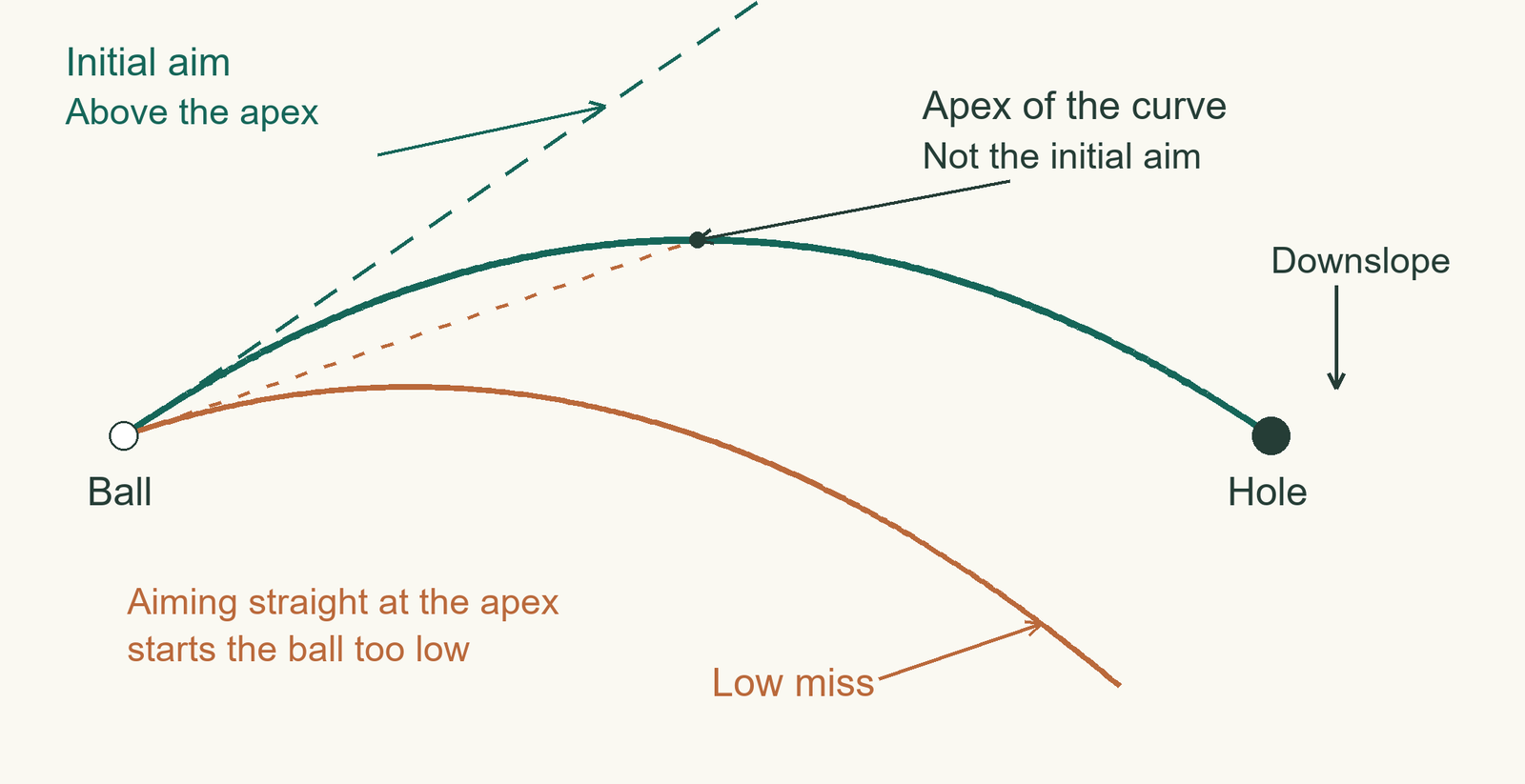
Do not aim straight at the apex
The apex is the high point of the imagined curve relative to the direct ball-to-hole line. It is a point the ball passes through. The ball does not travel straight there and then turn. On a simple breaking putt, it begins curving earlier, so the initial aim must be higher than a straight line drawn to the apex. [11]
Find the error before choosing an aid
Phil Kenyon’s lesson with Rick Shiels separates starting direction, speed and green reading. That is a useful way to organize practice because the final result alone mixes all three. [3]
First check the starting direction
On the practice green, find a short, nearly straight putt and place a ball gate about a foot ahead of the ball. Two tees work. Start with a generous gap, then narrow it as your control improves. This is a gate for the ball, not a gate around the putter head.
Roll ten balls through it with your normal routine. Frequent contact with one tee suggests a starting-direction problem or a poorly aligned gate. Recheck the gate before changing your stroke. Passing the gate tells you where the ball started; it does not prove that you read a breaking putt correctly.
Then check pace without a hole
Choose a flat target on the practice surface so balls can roll across it. From several distances, predict where each ball will stop and compare that intention with its actual finish. Include uphill and downhill putts. A real hole hides excess pace whenever the ball drops. This task makes that pace visible. [3]
If contact varies across the face, address that as well. A putter-head gate can help you notice off-center strikes, although a clean pass does not guarantee centered impact. Keep any strike-feedback attachments confined to practice and remove them before playing.
Finally test the read at a repeatable pace
Choose a modest breaking putt around 10–15 feet. Pick an initial aiming direction and a finish intention, then roll a small group. If the ball starts where intended and the pace is close, but the misses stay low, shift the aim slightly uphill and repeat without deliberately changing speed. Try the opposite break too.
This is a controlled practice experiment, not an instruction to add the same amount of break to every putt. On double-breaking greens, or when pace is inconsistent, the interpretation is less clear. A coach can help separate the variables.
Use feedback without becoming dependent on it
A yardstick is a useful at-home start-line test: roll the ball along a straight, level surface and see whether it stays on. Paige Spiranac demonstrates this without a specialist device. But falling off the ruler does not, by itself, tell you whether the cause is face angle, path, strike or the ruler’s setup. [7]
Finish the session with the gate or ruler removed. Give yourself only one ball from each new position. The test that matters is whether the improved behavior survives without the aid and without a second attempt at the same read.
What the simple equipment can tell you
A putting mirror checks the setup
An EyeLine mirror provides a reflected view and printed reference lines for eye position and face alignment; larger versions can show the shoulders. It is a visual reference, not a sensor measuring impact. Clay Ballard mentions EyeLine in the ranked lessons, while Danny Maude demonstrates a mirror in a separate lesson. We have not established their exact mirror models. [10][12][13]
There is an important disagreement here. Malaska warns against forcing everyone’s eyes directly over the ball; Maude describes correcting his own eyes being too far outside it. Use a verified straight line to test how your setup looks and performs, rather than treating one mirror position as a universal law. [2][12]
A return ramp supplies an indoor task
PuttOUT’s Premium Pressure Putt Trainer uses a ramp and a small target to challenge line and pace. The manufacturer associates a successful micro-target capture with a roll that would finish 18 inches beyond the hole. That is the product’s target condition, not the ideal speed for every real putt. [14]
It can make home practice more purposeful, but a flat mat does not teach you how a real side slope breaks. This is an additional product example, not a device identified in the top ten videos.
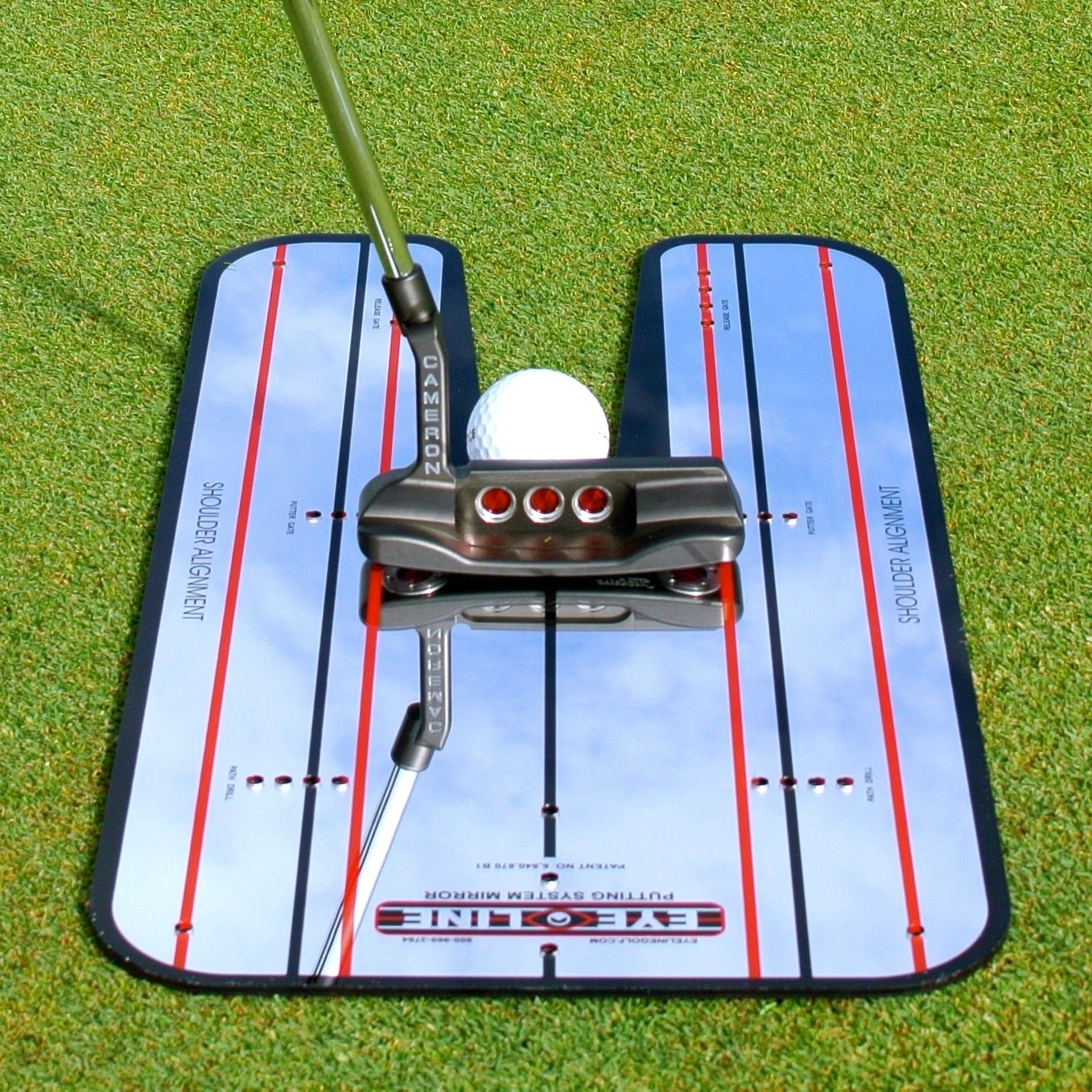
A product example of reflected setup references, not a measurement of impact. The exact mirror models in the cited videos are unconfirmed.
Photo source: EyeLine Golf — official product page ↗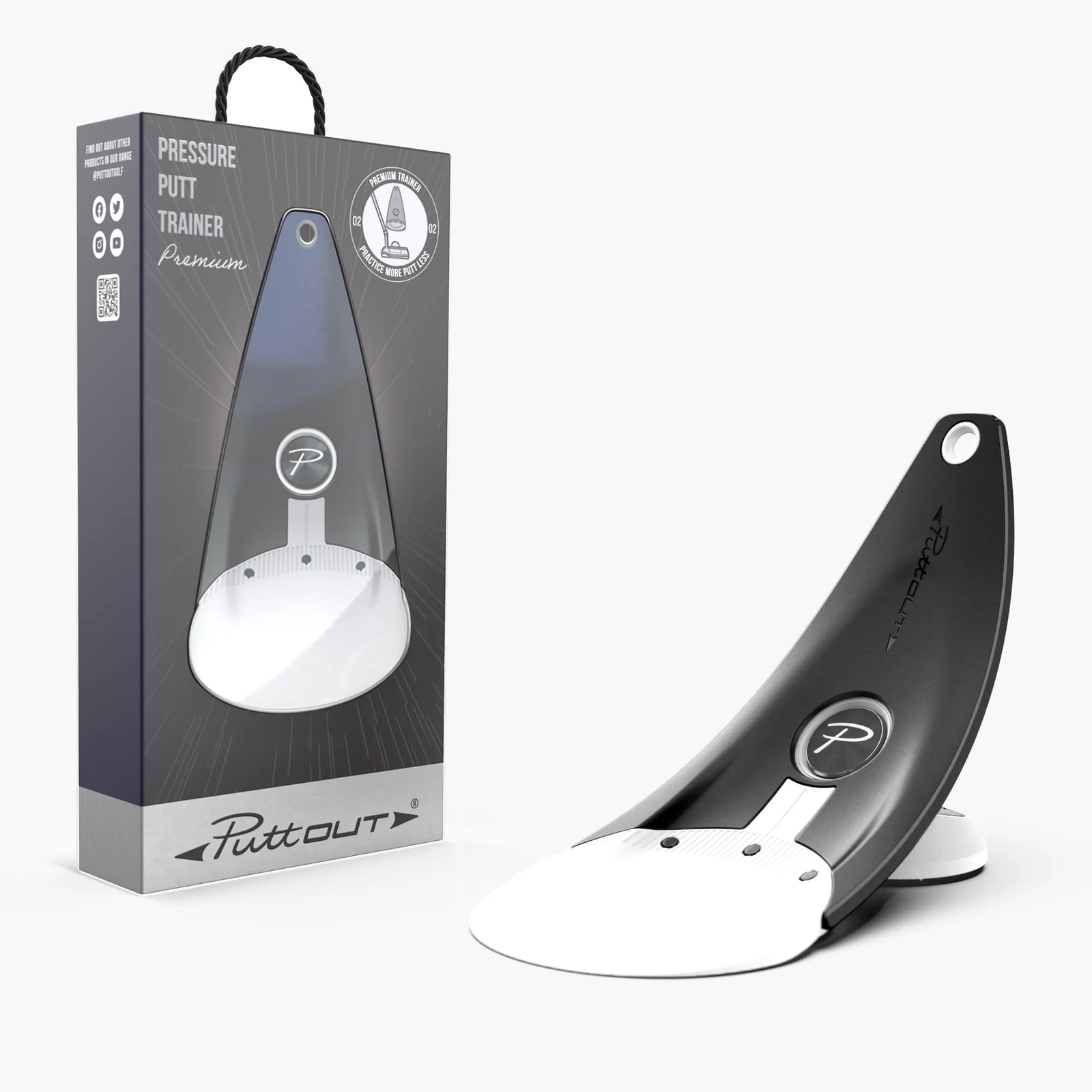
A product example of an indoor line-and-pace task, not a device identified in the ten ranked videos. Manufacturer photo; no personal testing is claimed.
Photo source: PuttOUT — official product page ↗When technology adds useful information
A digital level can help train slope perception
AimPoint Express combines feeling slope through the feet with a calibrated finger-based aiming reference. In Golf Sidekick’s explanation, a digital level is used during practice to compare the slope number with the sensation underfoot. This is especially relevant when the ball starts on your intended line but you repeatedly underestimate the break. [11][15]
The level measures the patch and direction beneath it, not the entire putt. It does not supply the correct pace. Set the display to percent slope, not degrees: a 2 percent slope rises 2 units over 100 horizontal units and is about 1.15 degrees. Confusing the two would make the calibration misleading.
A few fingers held in front of your face are not the whole method. Green speed, calibration and changes in slope still matter. Consider qualified instruction if you want to adopt AimPoint, and practice reading promptly without stepping on another player’s line. The digital level model in the supplemental video is not confirmed; a brand name is not necessary to understand the mechanism.
A fitting session can separate delivery from roll
If you cannot consistently start the ball where intended or control its roll after basic practice, a measured putting lesson may be more useful than buying another putter. Ask the fitter to explain the actual problem before recommending equipment.
SAM PuttLab uses ultrasound-based tracking to analyze the putting stroke, including face and motion information. Quintic Ball Roll uses high-speed camera analysis to examine the ball’s launch, speed and spin. They answer related but different questions: what the putter did, and what happened to the ball. [16][17]
Neither system on its own reads your next outdoor putt. Ask for a before-and-after comparison, repeated attempts, and a practice task that addresses the measured weakness. These are independently researched examples of fitting technology, not systems claimed to appear in the ten ranked lessons.
Brian DeLorge’s account of a Bettinardi fitting illustrates the distinction: his putter length changed for his delivery. That does not establish the right length, loft or head design for you. A branded putter in a successful player’s hands is not a controlled equipment test. [9]
Keep the training aids in practice
Do not use a digital level to measure slope during a Rules-governed round, or use a mirror, ruler or gate to help prepare for a stroke. Rule 4.3 restricts these uses of equipment. Practising on a designated practice green before play is different from using aids during the round. Check the Committee if uncertain. [18]
A practical session for the next round
Try this approximately 20-minute session on a practice green. The timings and scoring are our suggested routine, not a scientifically validated program or a promise of improvement.
Minutes 0 to 4
Calibrate pace. Putt to a flat target from 8, 12 and 18 feet, changing the distance each time. Predict the finish before each stroke. Include an uphill and a downhill direction. Record whether the pace matched your intention, rather than counting only makes.
Minutes 4 to 8
Check the start. Use the ball gate on a nearly straight putt. Count clean passes out of ten. If the setup feels uncertain, use a mirror briefly, then remove it. Keep the gate easy enough that you can identify a pattern rather than merely collect failures.
Minutes 8 to 15
Test the break. Work on a modest right-to-left putt and a left-to-right putt around 10–15 feet. Keep the pace intention similar while adjusting aim. Note low, high, short or long misses, and whether the ball started where intended. Adjust only one thing at a time.
Minutes 15 to 20
Remove the aids. Play one ball from five different positions in the 8–20-foot range, holing out each time. Record three-putts and the quality of the first putt. Include a few short return putts; the Mickelson circle drill is a reminder that confidence in the next stroke matters too. [8]
What to buy first
For repeated low misses with a reliable start and pace, put the effort into green reading; a calibrated slope lesson is more relevant than a new head design. For inconsistent starts, begin with two tees or a yardstick, adding a mirror if your setup needs a reference. For persistent delivery or roll problems, seek a measured lesson or fitting.
During your next few rounds, jot down distance, break direction and where each miss finished. “Low and short” is different evidence from “low and three feet past.” Use that record to plan your next practice.
The next time a putt slips below the hole, resist sending the putter straight to the used-club rack. Give yourself a better explanation first.
How this guide was made
This research synthesis includes an original practice routine and illustrations, not personal product testing. Demonstrations and testimonials do not establish typical results.
The ten most viewed lessons in our search
Views checked September 10, 2026. We searched “golf putting tips,” “golf putting drills” and “golf green reading” using YouTube’s Popularity filter, then ranked eligible results by public counts. This bounded sample is not an exhaustive YouTube-wide ranking. Counts change.
We included English-language putting instruction, including short-putt fundamentals. We excluded Shorts, highlights, challenges and primarily chipping or mixed short-game lessons. Equipment notes refer to the cited transcript passages, not an inventory of every video frame.
1 Cahill Golf Schools
Easiest Putting Technique Ever
2,803,649 views. Relevant passages: 0:42–2:25 and 6:35–7:06. Putter, balls and an alignment stick; a chalk line is suggested. One-handed practice explores a comfortable stroke. No electronic measurement is identified in these passages.
2 BE BETTER GOLF
THIS is the MOST IMPORTANT THING in Putting, Mike MALASKA on Be Better Golf
2,120,022 views. Relevant passages: 3:39–6:52. String and a flush tee reference establish a straight line. Malaska describes a Bullseye putter from his own history. The useful test is whether the verified line looks straight from the golfer’s setup.
3 Rick Shiels Golf
2,042,791 views. Relevant passages: 1:28–2:06 and 3:32–6:26. Two tees form a ball gate; sticky tack brackets the strike area; a flat target substitutes for a hole. Phil Kenyon separates starting direction, speed and reading. These are diagnostic tasks, not a branded shopping list.
4 Rick Shiels Golf
7 STUPID putting MISTAKES most golfers make!
1,919,842 views. Relevant passages: 1:54–2:54 and 7:30–8:26. Tees and Blu Tack provide target and contact feedback. The under-reading demonstration is directly relevant to low-side misses; it is coaching advice, not a measured claim about every amateur.
5 The Rick Shiels Golf Show
I get a Lesson from the WORLDS BEST Putting Coach (Brad Faxon)
1,778,269 views. Relevant passages: 4:36–6:08 and 13:00–14:42. A yardstick checks length, video checks setup, and a Sharpie marks a repeatable practice spot. Faxon identifies his Scotty Cameron at 24:08–24:20, but this is not a comparison proving that putter is better.
6 Paul Wilson Golf
The Best Putting Tip Ever! (No Joke - Try It)
1,524,450 views. Relevant passages: 1:38–3:40. Putter and balls; the wiggle drill shifts attention toward the target. No special aid is required. Treat the striking success claims as the coach’s anecdote, not a guaranteed outcome.
7 Paige Spiranac
My Favorite At Home Putting Tip & Drill
1,468,204 views. Relevant passages: 3:33–5:19. An ordinary yardstick supplies immediate start-direction feedback. Keeping the ball on it is useful feedback, but falling off alone cannot diagnose a specific spin fault. No premium rail is necessary to try the idea.
8 Willow Glen Basketball
BEST PUTTING DRILL EVER! [Phil Mickelson]
1,413,669 views. Relevant passages: 1:31–3:30 and 5:26–5:54. Tees and a club lay out a three-foot circle. This is an archival third-party upload, not Mickelson’s own channel. Its relevance is confidence in the next putt; it does not directly teach mid-range green reading.
9 Brian DeLorge | BRDE Golf
12 Putting Tips I Wish I Knew SOONER!
1,381,327 views. Relevant passages: 7:55–8:30 and 16:15–17:23. A tee is used for a strike drill. DeLorge reports a Bettinardi fitting and a change from 34.5 to 33 inches. That is an individual fitting story, not a prescription to shorten everyone’s putter.
10 Top Speed Golf - Clay Ballard
1,172,872 views. Relevant passages: 4:18–5:01 and 7:43–8:12. Ballard mentions an EyeLine putting mirror and demonstrates putting fundamentals. The exact mirror model is not established. His pace advice is a coaching preference, not a universal roll-past distance.
Additional sources and product references
11 Golf Sidekick on AimPoint Express
620,155 views when checked. Supplemental, not in the top ten. See 0:10–2:20 for level calibration, 3:24–4:57 and 8:30–10:24 for aim versus apex. An individual explanation, not a complete certified course.
12 Danny Maude on setup and a putting mirror
1,082,410 views; below the final top-ten cutoff. See 3:35–4:45 for the mirror and 5:21–5:40 for the routine. Exact mirror model not established.
13 EyeLine Golf Putting Mirrors
Manufacturer documentation for reflected setup references and differences between small and large mirrors. Product example: https://eyelinegolf.com/products/eyeline-putting-mirror-1
14 PuttOUT Premium Pressure Putt Trainer
Manufacturer product description. Used for the ramp, micro-target and stated 18-inch target condition, not independent proof of improvement.
Official explanation of the feet-and-fingers method. Marketing success claims are not used as evidence of likely gains.
16 SAM PuttLab installation guide and features
Official ultrasound technology description. Reporting features: https://www.scienceandmotion.com/puttlab-features/
17 Quintic Ball Roll applications
Official description of high-speed camera measurement of launch, speed and spin. Does not establish on-course improvement.
See 4.3a(1) and 4.3a(6) for elevation measurement and training-aid restrictions during a round.