A rangefinder seems to have a straightforward job: tell us how far away something is.
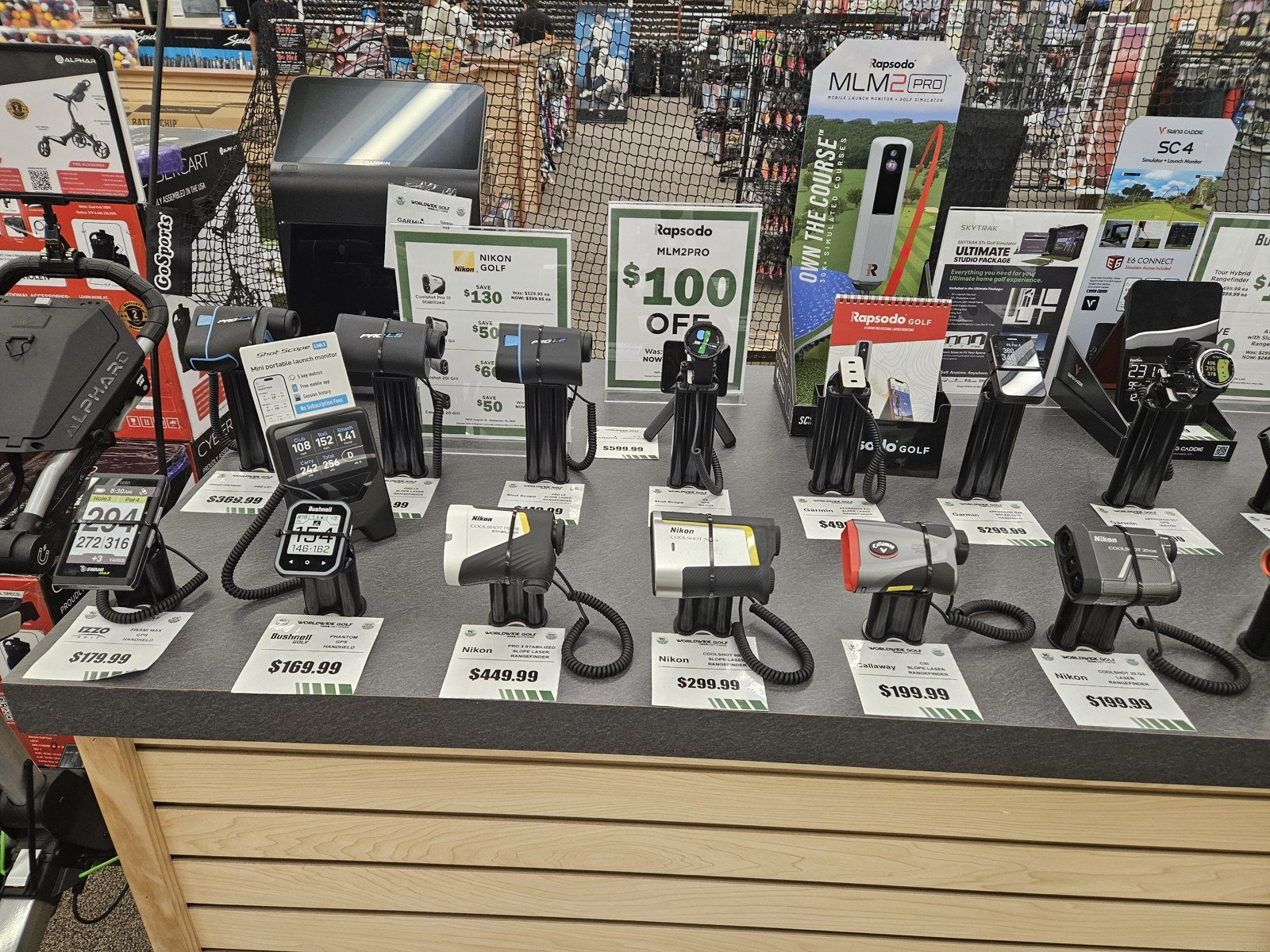
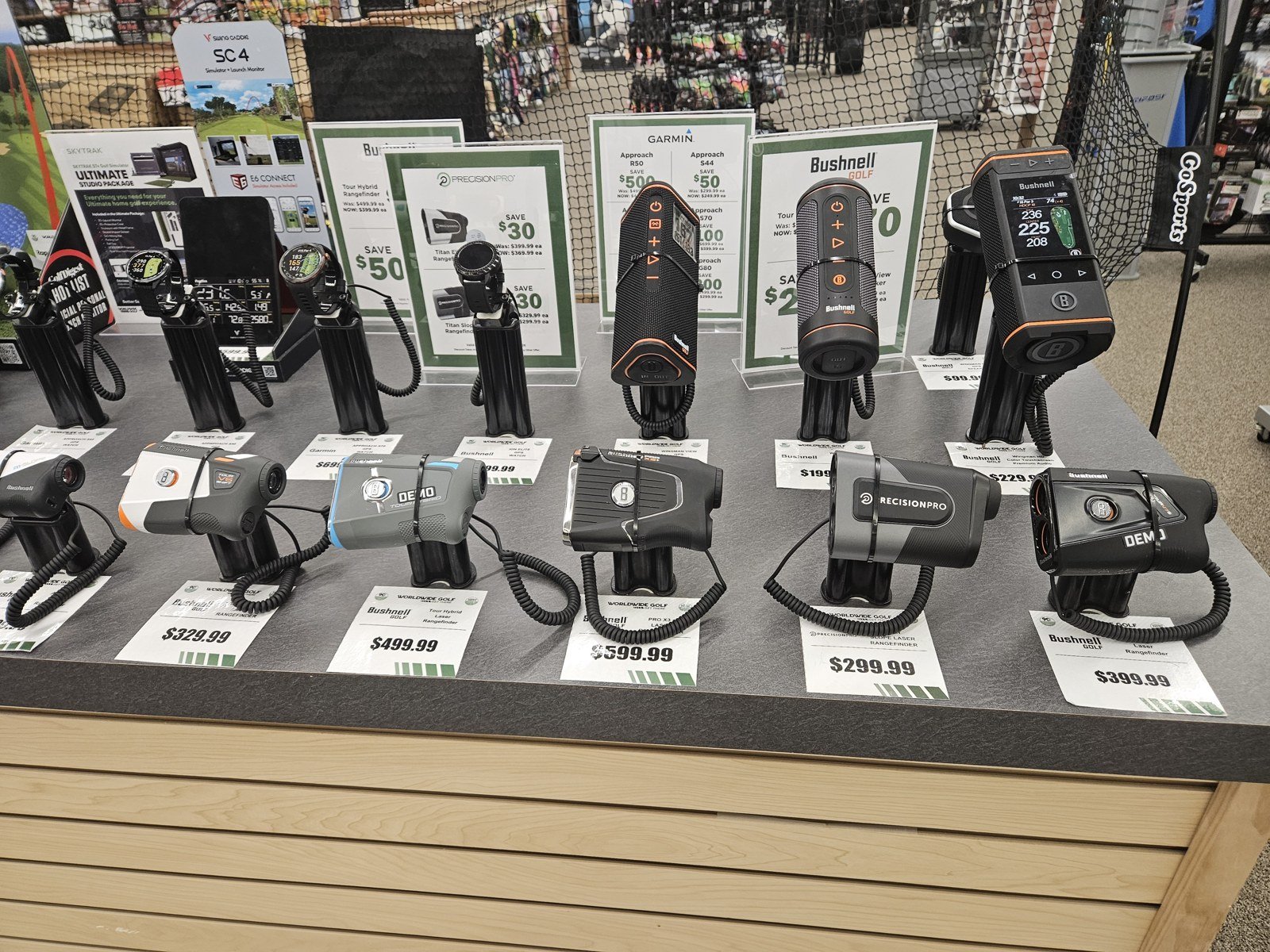
That makes the price spread difficult to understand. The store display pictured here includes a Bushnell Tour Hybrid tagged at $499.99, alongside models costing considerably less—and a Bushnell Pro X3+ tagged at $599.99.
Meanwhile, rangefinders selling for under $100 also promise accurate distances, slope compensation, and flag-lock vibration.
If they all measure the same flag, why pay several hundred dollars more? And why do two rangefinders sometimes disagree by a few yards?
The answer starts with three separate questions: Did it measure accurately? Did it measure the right object? And what kind of distance is it displaying?
Why two devices can give different numbers
A laser rangefinder sends an invisible light pulse toward a target and measures how long the reflection takes to return. That travel time becomes a distance. Nikon describes this process in its rangefinder manual. Nikon manual
But a digital number is not a promise of perfect measurement.
Consider a simplified example: a target is exactly 150 yards away, and two devices each have an applicable accuracy tolerance of ±1 yard. One could display 149 and the other 151 while both remain within that tolerance. This illustrates how a two-yard disagreement can happen; it does not establish how frequently either device would produce those readings.
Display resolution is another distinction. Showing tenths of a yard means the screen can display smaller increments. It does not, by itself, prove accuracy to one-tenth of a yard.
Then there is the target itself. A flagstick is narrow, your hands move, and trees may sit behind the green. A device can produce a plausible distance to something other than the flag.
Nikon’s First Target Priority system, for example, selects the nearer subject when targets overlap. Its lock indicator signals that selection. The practical implication is that a vibration should be treated as helpful confirmation, not independent proof that the device understood your intended target. See Nikon’s explanation of target selection. Nikon target selection
Conditions also matter. Nikon lists rain, fog, small or dark targets, moving targets, and obstructed sightlines among situations that can cause inaccurate or unsuccessful measurements. These problems do not necessarily produce a tidy, predictable two-yard error. Sometimes they produce no reading—or a reading worth questioning. Nikon manual
Sometimes the devices are answering different questions
Before comparing numbers, check the measurement mode.
| Number displayed | What it represents |
|---|---|
| Actual laser distance | Direct distance from the device to the object measured |
| Slope-adjusted distance | A calculated playing-distance guide accounting for uphill or downhill terrain |
| GPS front, center, or back | Distance to a mapped part of the green, rather than necessarily to today’s flag |
The Bushnell Tour Hybrid combines laser readings with GPS green distances. Those numbers serve different purposes and should not be expected to match. Bushnell Tour Hybrid
Slope adds another layer. Manufacturers can use different methods to calculate a playing-distance recommendation. Nikon documents a horizontal-distance-plus-or-minus-height approach for its COOLSHOT 50i; Bushnell says its Tour Hybrid slope algorithm incorporates ball trajectory. Two devices agreeing on the direct distance could therefore disagree on the adjusted number without their lasers disagreeing. Nikon ID Technology, Bushnell Tour Hybrid
A useful first check is simple: stand in the same place, select yards on both devices, turn slope off, and measure the same target.
What the extra money can buy
The surprising part is how similar headline accuracy claims can look.
Gogogo’s GS24 series page lists a $99.90 price and advertises ±1-yard accuracy, slope compensation, and flag-lock vibration. The page covers multiple variants, so buyers need to check the selected model and availability. Bushnell specifies ±1-yard ranging accuracy at 500 yards for the Tour Hybrid. The published conditions are not sufficiently matched to establish equal real-world performance. Gogogo GS24, Bushnell Tour Hybrid
That comparison does establish something useful: a fivefold price difference does not automatically buy a fivefold improvement in the advertised accuracy figure.
Premium features can instead address other problems:
| Feature | What it can help with |
|---|---|
| Image stabilization | Keeping a distant target steady enough to aim at |
| Optics and readable displays | Seeing the flag and reading the number comfortably |
| Target-selection systems | Separating a nearer target from its background |
| Integrated GPS | Adding green-depth context to a flag distance |
| Weather protection and warranty | Matching the device to playing conditions and ownership needs |
These features are model-specific. An expensive rangefinder does not necessarily include all of them, and budget models can include some.
For example, Nikon’s COOLSHOT PROIII STABILIZED includes stabilization, a red OLED display, and a claimed measurement response of approximately 0.1 second under Nikon’s conditions. These are specific capabilities to evaluate, not proof that every reading will beat a cheaper device. Nikon product announcement
The $499.99 Tour Hybrid in the photograph makes a different proposition: laser distance plus GPS front, center, and back distances in the viewfinder. Part of that purchase is additional information about the green.
Neither feature list tells us how much of the retail price pays for hardware, development, distribution, marketing, or margin. Public specifications cannot provide that breakdown.
What golfers report after using them
Most golfers want a dependable number and to get on with the shot. Accounts from people who have used these devices help explain what a higher price might change, without asking every buyer to run a benchmark.
A budget model can satisfy its owner even when it has compromises. In an August 2020 Golf Monthly forum discussion, larmen said a Boblov usually read within a yard of playing partners' devices, but described difficulty keeping both the flag and displayed number in focus. Another member, chico, reported two satisfactory years with a roughly £60 Toner that usually matched more expensive units. These are reports of agreement and usability, not independently verified accuracy. Golf Monthly owner discussion
The same thread shows why a follow-up matters. Orikoru initially described a Ben Sayers as generally usable despite occasional freezing and background-tree readings. Two days later, the owner reported that it had stopped working after 11 months. That is one device's history, not a failure rate for budget rangefinders. Original report and follow-up
Stabilization offers a more specific reason to spend. In his November 2023 GolfWRX review of the Nikon COOLSHOT PRO II STABILIZED, Brian Knudson said he could aim at 120–150-yard targets with one hand instead of supporting his aiming hand with the other. That is a published reviewer's firsthand experience with the PRO II, not a Golf Unpacked test or evidence that the newer PROIII is more accurate. Brian Knudson review
A premium price is no guarantee of trouble-free ownership either. In Reddit's Rangefinder assistance discussion, volzjr57 reported a focusing failure on a Bushnell Tour V5 Shift and said a sub-$100 replacement had outlasted it. In the same discussion, Onewood reported five to six years of use from a Bushnell. These unverified owner accounts point in different directions; neither establishes how often a brand fails. Reddit owner accounts
Our takeaway is to pay for a benefit you can identify. If your current device finds the flag reliably and its display is comfortable to read, a similar number on a more expensive model is little reason to replace it. If hand movement makes aiming frustrating, stabilization is a relevant feature to consider. If you want green-depth context as well as a flag distance, GPS addresses that need. When reading reviews, look for those specific situations and longer-term updates rather than treating one matching yardage or a high star rating as the whole story. The extra $400 needs to solve a problem you actually have.
Sources and evidence notes
Manufacturer sources establish published specifications and intended functions. The experience sources describe individual use, not controlled comparisons or representative failure rates. Product sources and experience references checked October 4, 2026. Prices and availability can change.
Laser measurement principle and conditions that can interfere with readings.
First Target Priority and lock confirmation.
GPS and laser functions, slope algorithm and stated accuracy.
Documented slope adjustment approach for the COOLSHOT 50i.
Listed price, claimed accuracy and variant differences.
COOLSHOT PROIII stabilization, display and claimed response time.
User Experience Sources. August 6–8, 2020; larmen, chico and Orikoru, including the later failure update. Older devices; self-reported ownership. Accessed October 4, 2026.
User Experience Sources. Brian Knudson, November 22, 2023. COOLSHOT PRO II STABILIZED aiming experience; not a PROIII comparison. Accessed October 4, 2026.
User Experience Sources. Rangefinder assistance; volzjr57 and Onewood. Opposing ownership reports; identities and failures not independently verified. Accessed October 4, 2026.
Additional supplied photograph