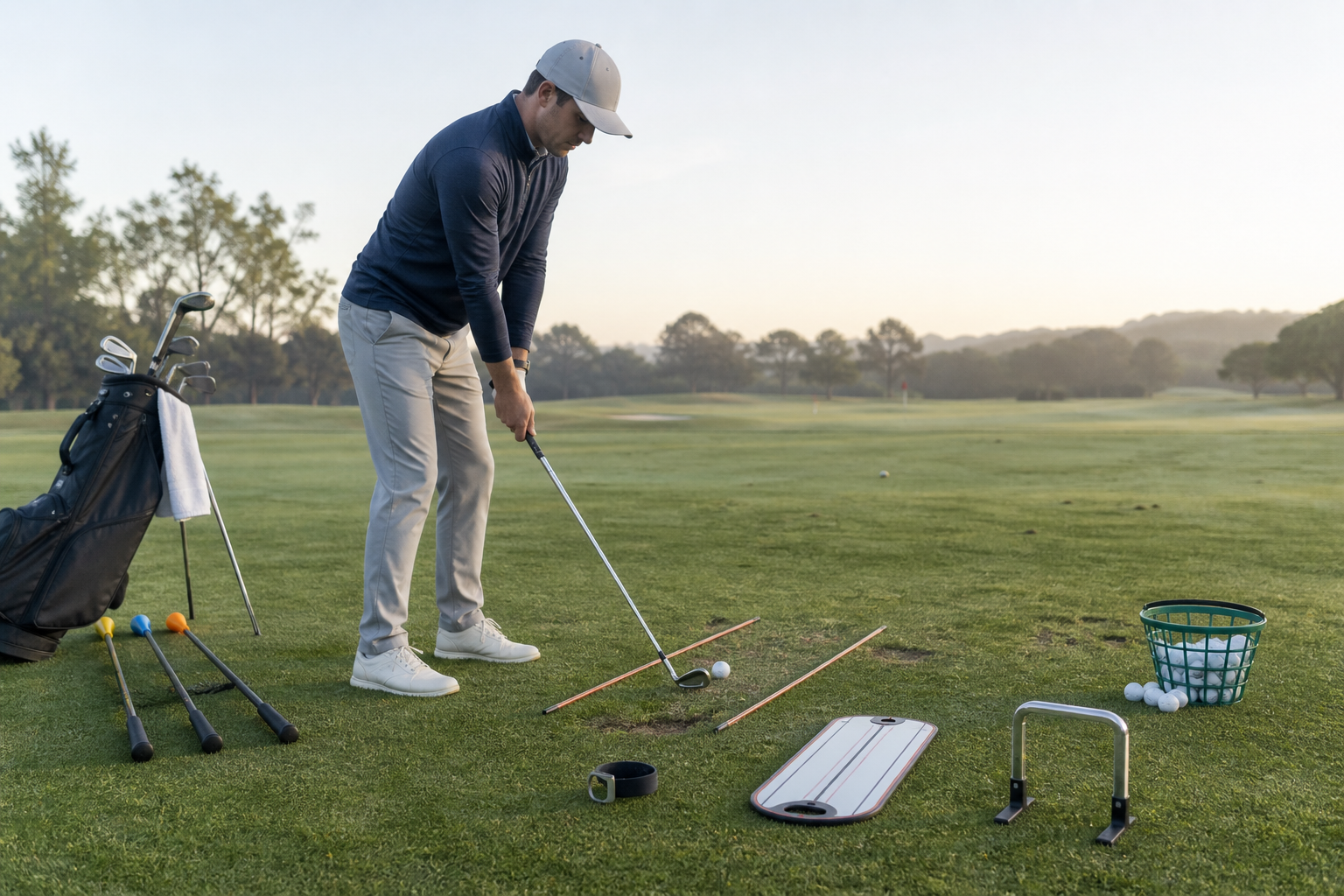
A training aid is not a result. It is a practice condition. Its job is to make something easier to see, harder to avoid, more obvious to feel, different to load or more meaningful to repeat.
The useful buying question is not, “Does this aid work?” It is: “What does it change during practice, and how will I know the change survives when the aid is removed?”
Golf-specific motor-learning research provides some support for augmented feedback, variable practice and an external focus of attention, but the evidence is not strong enough to declare one universal method best. A 2024 systematic review found 52 randomized studies, yet many were underpowered and many used simple putting tasks with novices. That makes confident product-level promises difficult.[1]
There is no audited sales table covering every kind of golf training aid. The products below are popular representative examples selected from visible signals such as longevity, review volume, reported users, reported sales and category recognition. Popularity is not evidence that a product works better.
Why mechanism matters more than the product category
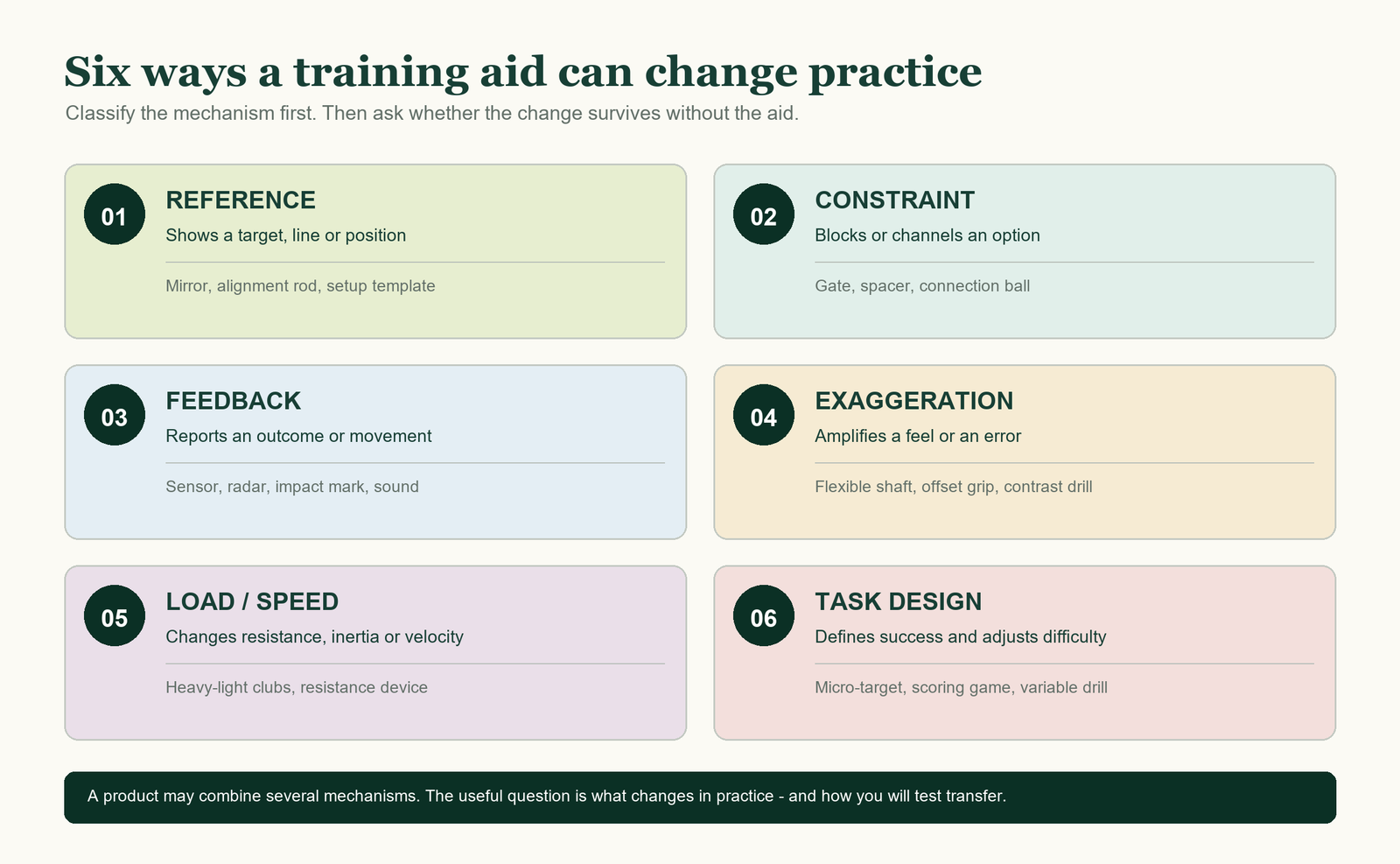
Two products sold for the same fault may teach in completely different ways. A wrist sensor reports measured motion. A foam ball between the forearms prevents separation. A mirror provides a visual reference. A flexible shaft exaggerates timing and balance. They may all be marketed as swing aids, but they create different information and different risks.
The same product may combine mechanisms. A putting gate is a constraint because the ball must pass through it, but it is also feedback because a collision makes the error obvious. A speed-training system changes the load, while its radar or app supplies feedback and its protocol supplies task design.
An aid can make today’s repetitions look better because it guides the motion or simplifies the task. Learning is the harder test: can the golfer reproduce the useful change later, without the aid, and under a different target, club, lie or level of pressure?
1. Reference and calibration
A reference aid shows the golfer where something is, or where it should appear. Alignment rods establish a target line. A putting mirror shows eye position, shoulder alignment or putter-face orientation. A marked mat provides distance and start-line references.
This mechanism is useful when the golfer’s internal picture is poorly calibrated. A player may feel square while aiming right; the reference exposes the mismatch. The aid does not force the correction and usually does not measure what happens dynamically through the whole stroke.
Popular example: Classic EyeLine Putting Mirror. EyeLine describes its original mirror as a product used by thousands of golfers over more than 20 years. That longevity makes it a useful category anchor, although the manufacturer does not publish audited market-share data. The mirror supplies reflected setup information and printed alignment lines; it does not measure the moving stroke.[7]
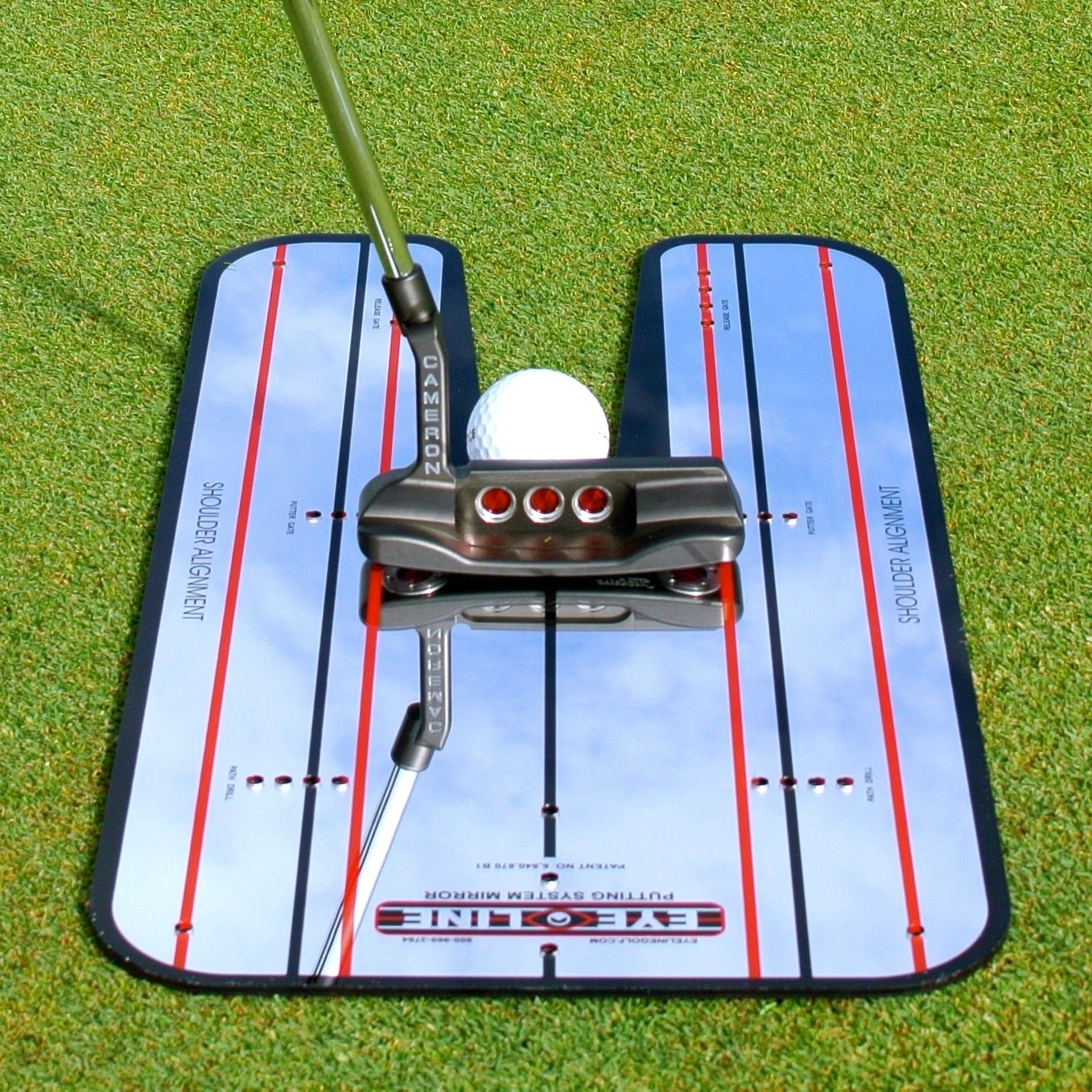
The mirror and printed lines make eye position, shoulder alignment and putter setup visible.
Manufacturer image and product source ↗Check the reference, make a small adjustment, then alternate repetitions with and without the visual guide. If the setup immediately drifts when the mirror or line disappears, the golfer has identified a dependency rather than completed the learning.
2. Constraint and channeling
A constraint changes the available movement options. A putting gate leaves room for a centered start but punishes a large face or path error. A connection ball between the forearms discourages excessive separation. A plane board or barrier removes part of the club’s available route.
Constraints can reduce the need for a long technical instruction: the task itself tells the golfer what will fit. But a narrow guide can also produce a motion that works only inside that setup. Make the constraint easier to escape over time—widen the gate, remove the spacer or change the target—and see whether the pattern remains.
Research on constraints-led practice across sport is promising but heterogeneous, and much of it is not golf-specific. Treat the mechanism as a way to shape exploration, not as proof that a particular device will create the intended swing.[3]
Popular example: Tour Striker Smart Ball. On September 2, 2026, the official product page displayed a 4.3/5 rating from 975 customer reviews—a strong visible adoption signal within connection-ball aids, though not an independent market-share measure. Held between the forearms, the ball constrains how far the arms can separate; losing it also provides immediate feedback.[9]
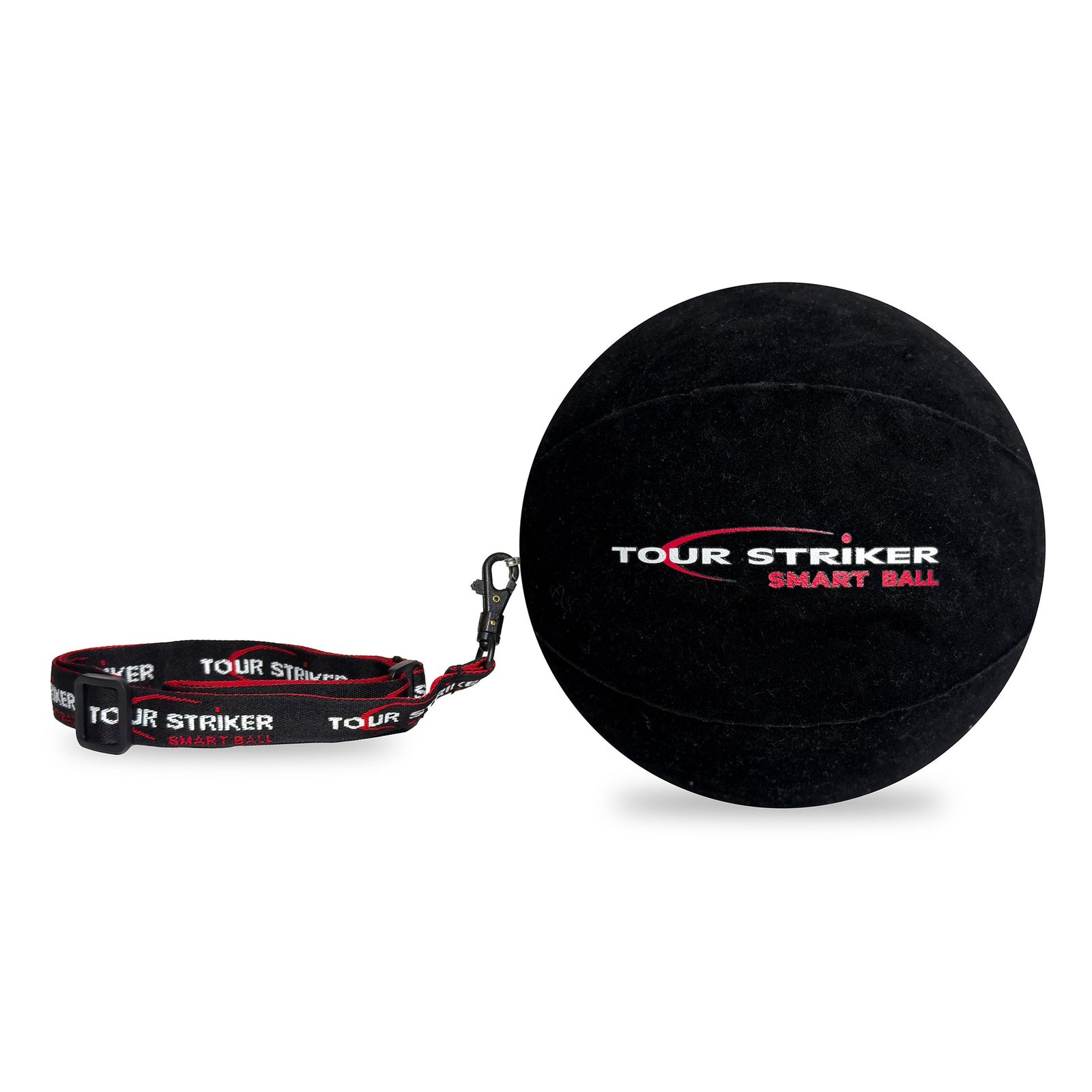
The inflatable ball and neck strap create a removable spacing constraint between the forearms.
Manufacturer image and product source ↗3. Augmented feedback
Golf already supplies intrinsic feedback: ball flight, strike sound, turf interaction and the feel of contact. Augmented feedback adds information that the golfer would not otherwise receive clearly. It may show club speed, impact location, wrist angle, launch conditions, face direction or a video trace.
HackMotion Core is a clear example. Its product page describes a wrist-worn sensor connected to an app, with motion sensing, haptic feedback and guided drills. That can turn an invisible wrist-angle pattern into a measurable signal. It does not, by itself, decide whether the selected wrist pattern is the correct priority for a particular golfer.[4]
Popular example: HackMotion Core. HackMotion reported that roughly 80,000 golfers had tried its system, while its Core page displayed a 4.5 rating from 4,542 reviews when checked on September 2, 2026. These are manufacturer-hosted popularity signals, not independently audited sales or proof of learning.[4]
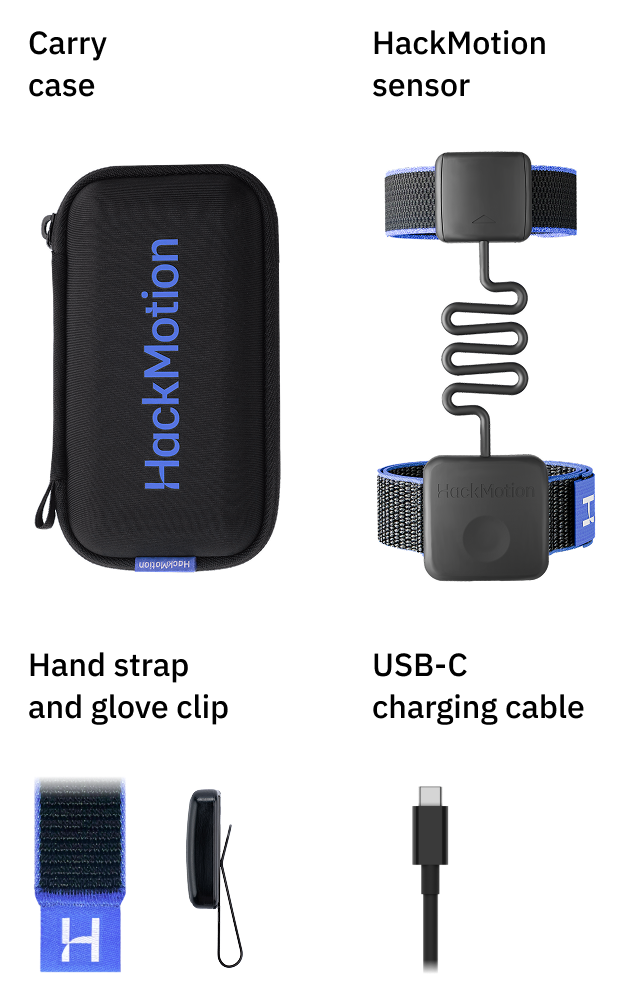
The wrist-worn sensor feeds measured motion to an app and can add audio, visual and haptic cues.
Manufacturer image and product source ↗More data is not automatically more learning. Research on augmented feedback finds potential value, especially when intrinsic information is hard to perceive, but results vary by skill, timing and feedback design. Some motor-learning work warns that continuous guidance can make the learner dependent on the signal; other studies find frequent, externally focused feedback useful. The practical answer is to test a faded schedule rather than assuming either extreme is always correct.[1][2]
Use the sensor or display for several repetitions, hide it for the next few, predict the result before checking again, and finish with the device removed. The goal is not to stop using information; it is to connect the information to ball flight, strike and an internal prediction.
4. Exaggeration and contrast
Some aids deliberately make a sensation or error larger. A flexible shaft magnifies poor sequencing and balance. An offset or shaped grip changes the relationship between the hands and club. An impact bag creates a more obvious collision point. A coach may also use the product to rehearse the opposite of a golfer’s habitual pattern.
Exaggeration is useful because subtle differences are hard to detect. It creates contrast: this feels clearly different from the old motion. But the exaggerated rehearsal is not necessarily the finished swing. The golfer needs a bridge back to a normal club, normal ball flight and a normal target.
Popular example: The Orange Whip Trainer. Its flexible shaft, weighted orange end and counterweight deliberately make rhythm, sequencing and balance easier to feel. The manufacturer calls it its number-one swing trainer, and PGA.com has described it as one of the most popular swing-improvement products. Those signals establish recognition, not comparative effectiveness.[10][11]
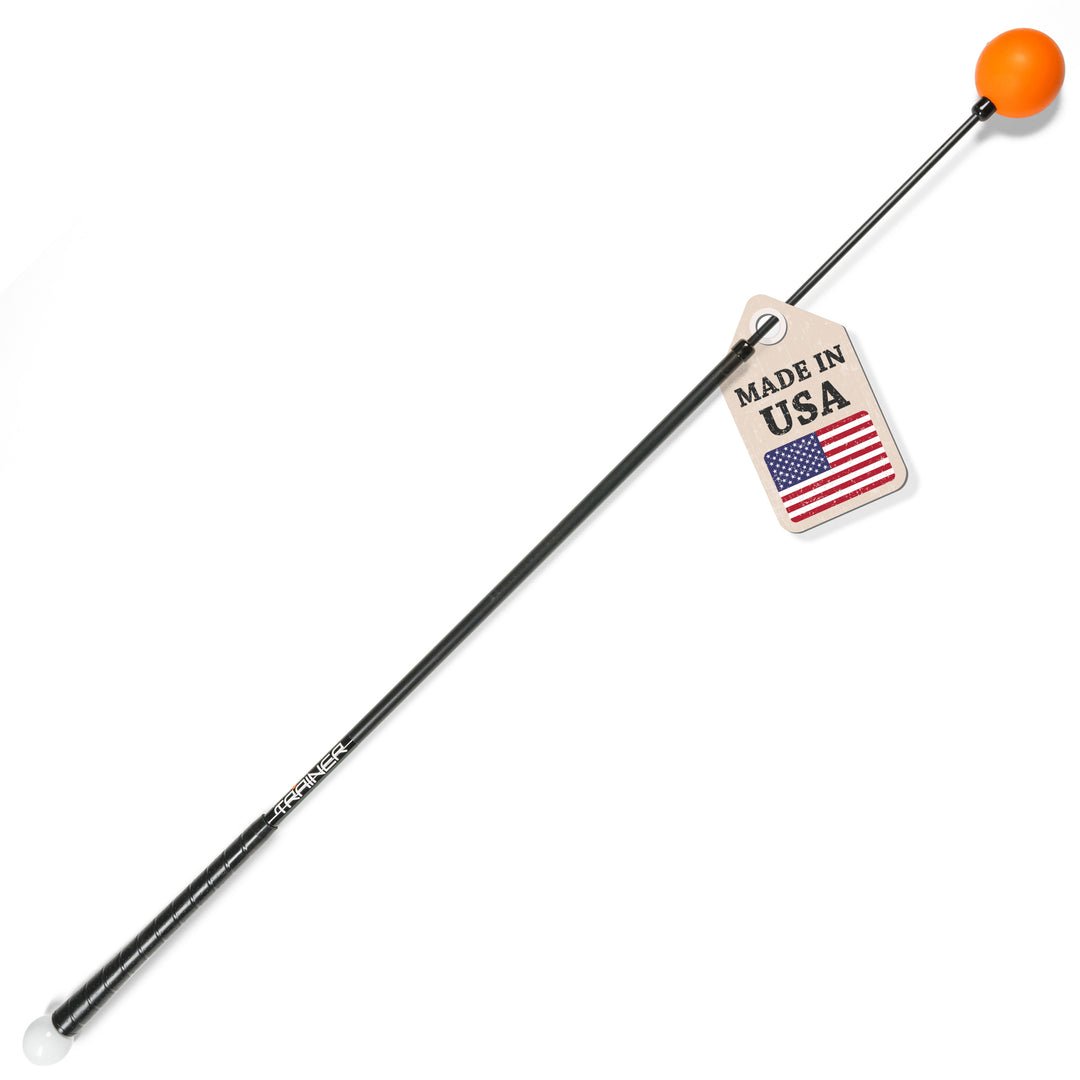
Its flexible shaft and counterbalanced weighted ends amplify timing, rhythm and balance sensations.
Manufacturer image and product source ↗After a small block with the exaggerated aid, switch immediately to the normal club and hit to a target. If the only repeatable outcome occurs with the unusual weight, shape or flexibility still present, the product is supplying the performance rather than teaching the golfer to reproduce it.
5. Load and speed manipulation
Load-based aids change resistance, inertia or the speed the golfer can produce. Heavy clubs, light clubs, resistance bands and counterbalanced trainers do not simply tell the player what happened; they change the physical task itself.
SuperSpeed’s Speed Sticks Pro illustrate the mechanism with three weighted training sticks and guided protocols. The company describes the set as light, medium and heavy and markets it for overspeed training. Those facts explain the design. Manufacturer-reported gains and user outcomes should still be treated as claims unless the underlying methods and independent evidence justify a stronger conclusion.[5]
Popular example: SuperSpeed Speed Sticks Pro. SuperSpeed reports use by more than 300,000 golfers and 1,000 tour professionals. That is a substantial manufacturer-reported adoption signal, but it is not an audited comparison with every speed-training system.[5]
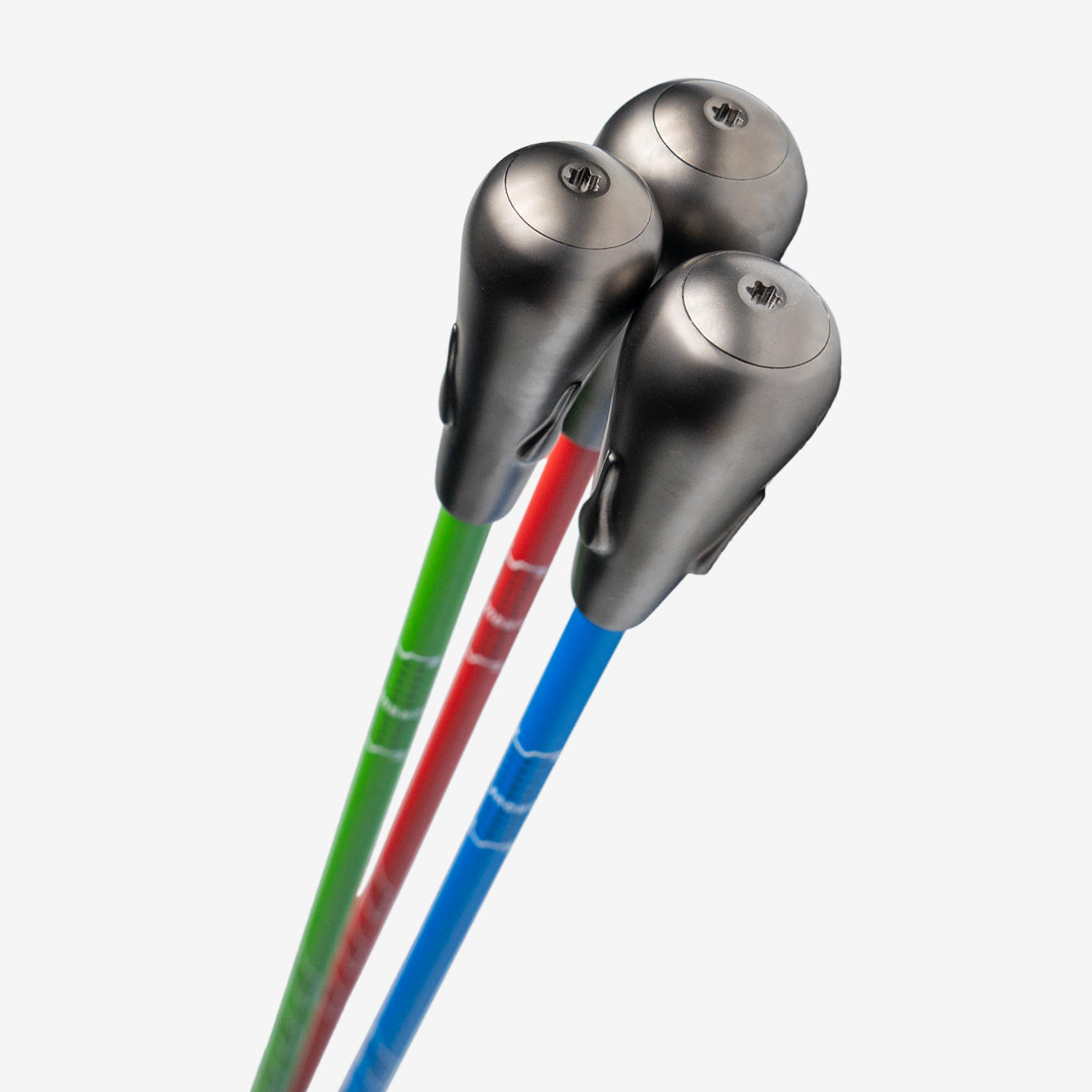
The three-stick system changes loading across a prescribed speed-training task.
Manufacturer image and product source ↗The measurement should match the goal. If the objective is more driver speed, track normal-driver speed and ball speed as well as the training-stick number. Recheck after rest and on another day. A faster light-stick swing during the session is not the same result as a durable increase with the golfer’s normal club.
6. Task design and progression
A task-design aid turns repetition into a defined problem. It gives the golfer a target, a success condition, a score or a progression. The product may be mechanically simple; its value lies in how it organizes attention and difficulty.
The PuttOUT Premium Pressure Putt Trainer combines several mechanisms, but task design is central. Its parabolic ramp returns made putts according to pace, rejects poorly paced edge entries and includes a smaller micro-target that the manufacturer says accepts only a putt with the intended line and speed. The golfer receives a clear challenge instead of merely rolling balls across carpet.[6]
Popular example: PuttOUT Premium Pressure Putt Trainer. The official page reported more than 500,000 units sold and displayed a 4.6 rating from 112 reviews when checked on September 2, 2026. The sales figure is manufacturer-reported, but it provides a clearer popularity signal than a general “best aid” claim.[6]
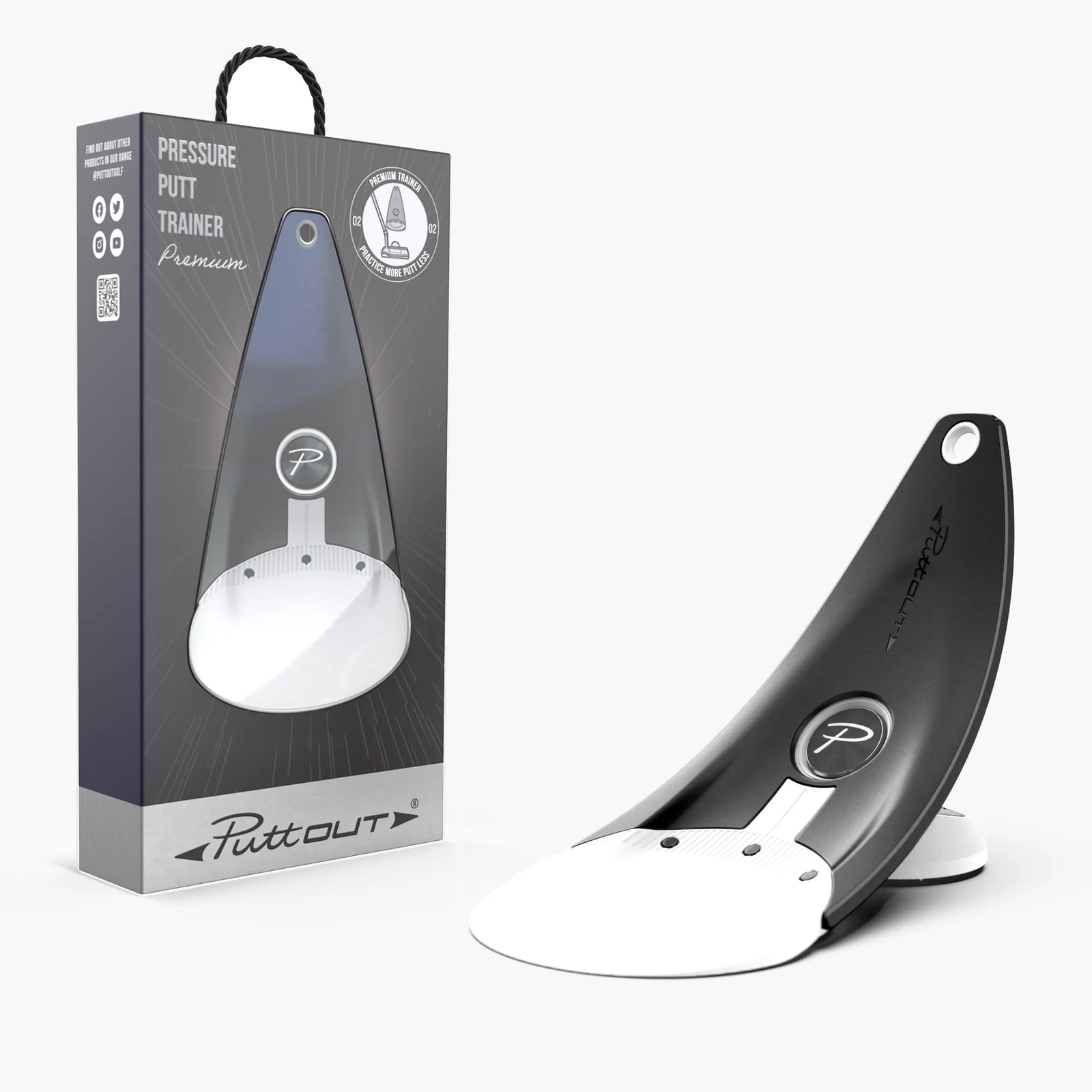
The ramp, return distance and micro-target create outcome feedback and an adjustable success condition.
Manufacturer image and product source ↗A well-designed task should change as skill improves. Alter the distance, break, target size, scoring rule or consequence. Research in golf suggests that variable and increasingly challenging practice can support learning, but the optimal difficulty depends on the golfer and task. Too easy supplies little information; too hard can turn every attempt into noise.[1]
How to choose an aid without buying the promise
| Question | A useful answer sounds like | Warning sign |
|---|---|---|
| What variable changes? | Start line, strike location, wrist angle, speed, setup or another defined variable | It claims to fix the whole swing |
| What is the mechanism? | Reference, constraint, feedback, exaggeration, load or task design | The explanation is only testimonials |
| How is success measured? | A visible outcome with a baseline and a repeatable test | Success means the drill feels good |
| How is the aid removed? | The protocol fades guidance and returns to normal clubs, targets and conditions | Every useful repetition requires the product |
| What transfers? | The same outcome appears later and in a changed condition | Only the in-session best attempt is reported |
| What evidence supports it? | Product design, manufacturer claims, user experience and independent research are separated | All evidence types are blended into one promise |
A practical 15-minute test protocol
This is a practice template, not a validated prescription. Adjust repetition count for fatigue, safety and the type of skill.
- Baseline: Make three to five normal attempts without the aid and record the outcome that matters.
- Guided block: Use the aid for six to ten attempts while focusing on its one intended signal or constraint.
- Prediction block: Before seeing the feedback, predict the result. Then check whether your perception is becoming calibrated.
- Fade: Reduce the feedback frequency, widen the constraint or alternate aided and unaided attempts.
- Transfer: Finish with the normal club or setup, a different target or distance, and no aid.
- Retention: Repeat the baseline later or on another day. Compare the ordinary condition, not only the best guided repetition.
A training aid becomes hard to evaluate when the golfer changes grip, posture, backswing, target and tempo at the same time. Give the product one job, choose one outcome, and decide in advance what would count as useful transfer.
Bottom line
The most useful training-aid question is mechanical before it is commercial: what does this object change in the practice environment?
References help calibrate. Constraints shape options. Feedback reveals information. Exaggeration creates contrast. Load changes the physical demand. Task design gives repetitions a goal and progression. Any of those mechanisms can be useful when it matches a real problem and is followed by an unaided transfer test.
The product is not the learning. It is temporary scaffolding. Judge it by what the golfer can still do when the scaffolding comes away.
Sources
Research and product sources checked September 2, 2026. Manufacturer pages establish product design and stated function, not independent efficacy.
- Motor learning in golf: a systematic review — Used for evidence limits, augmented feedback, practice variability, focus of attention and challenge-point discussion.
- Frequent external-focus feedback enhances motor learning — Used to explain why feedback frequency and attentional focus matter.
- Constraint-led approach in sport: systematic review and meta-analysis — Used cautiously to describe task constraints; the evidence is largely outside individual golf technique.
- HackMotion Core official product page — Used for the wrist-sensor, app, feedback and guided-drill design, plus manufacturer-hosted adoption signals.
- SuperSpeed Golf official site — Used for the three-stick Speed Sticks Pro design, protocol and reported adoption.
- PuttOUT Premium Pressure Putt Trainer official product page — Used for ramp behavior, micro-target, adjustable target and manufacturer-reported sales.
- EyeLine Classic Putting Mirror official product page — Used for the mirror design, alignment references and product longevity.
- Reporting bias, not external focus: Bayesian meta-analysis — Used to temper broad claims that an external focus is universally superior.
- Tour Striker Smart Ball official product page — Used for the inflatable connection-ball design and time-stamped review volume.
- Orange Whip Trainer official product page — Used for the flexible-shaft, weighted-end and counterbalanced design.
- PGA.com: popular training products — Used as an independent category-recognition signal for the Orange Whip.