
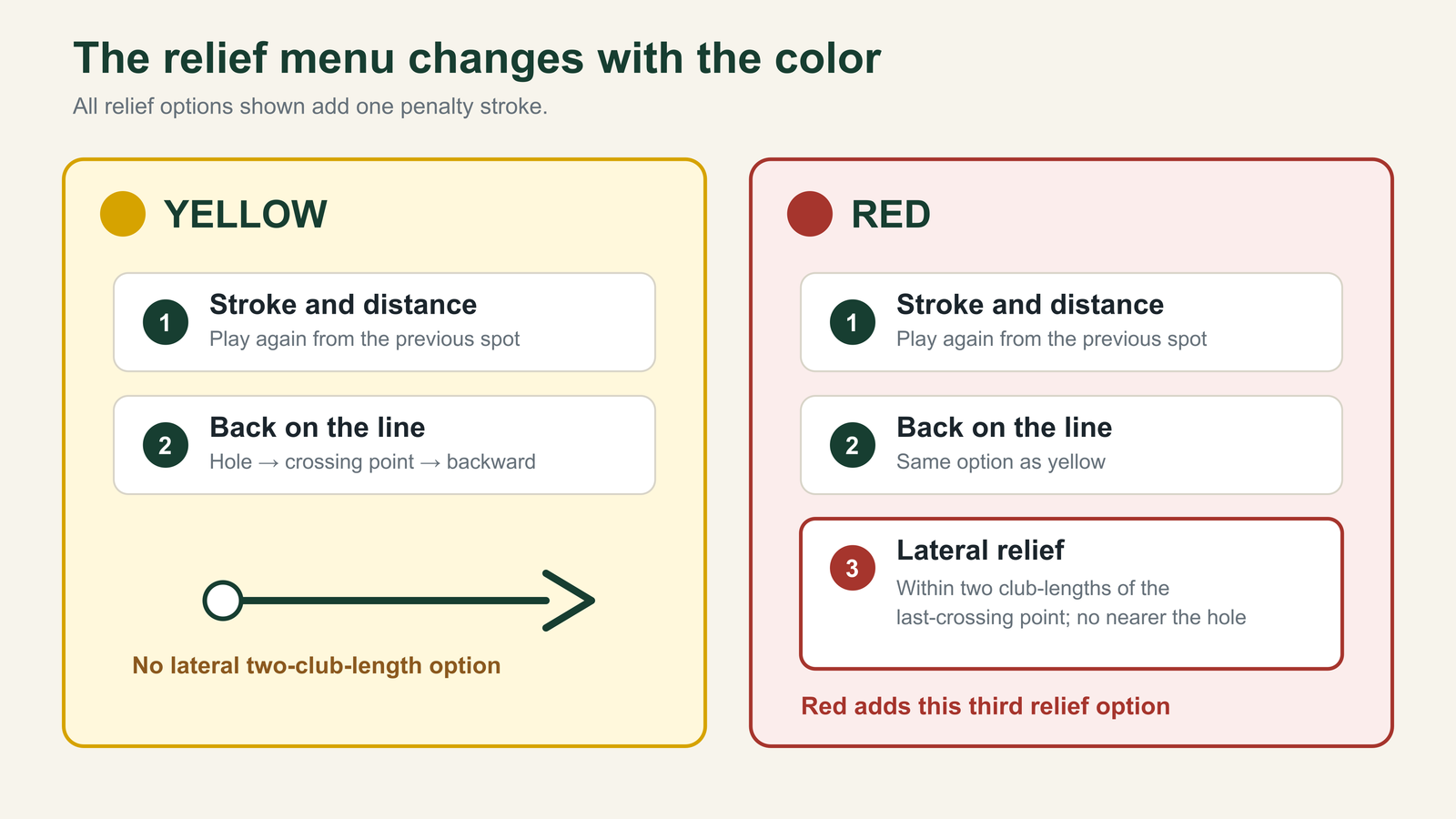
Yellow gives two one-stroke relief options: stroke and distance or back on the line. Red gives those same two options plus lateral relief within two club-lengths of where the ball last crossed the edge.
When a ball is in a penalty area, you may play it as it lies without penalty. If you take relief outside the penalty area, add one penalty stroke.[1]
| Option | Yellow penalty area | Red penalty area |
|---|---|---|
| Play the ball as it lies | Yes—no penalty | Yes—no penalty |
| Stroke-and-distance relief | Yes—one penalty stroke | Yes—one penalty stroke |
| Back-on-the-line relief | Yes—one penalty stroke | Yes—one penalty stroke |
| Lateral relief within two club-lengths | No | Yes—one penalty stroke |
Rule source: Rule 17.1d. The fourth row is the only relief option created by the color difference.[1][2]
Yellow: two relief choices. Red: those two plus lateral relief. The penalty is one stroke either way; red changes where you may drop, not the size of the penalty.
First, call it a penalty area
Golfers often say “water hazard” or simply “hazard.” The modern Rules use penalty area. The term is broader than water: a Committee may define a desert, wooded area, lava field, or another difficult-to-play area as a penalty area.[2][3]
A penalty area is either red or yellow. If the Committee has not marked or indicated a color, it is treated as red.[3]
Is the ball actually in the penalty area?
A ball is in a penalty area when any part of it lies on or touches the ground or anything else inside the edge, or is above the edge. The painted line itself is inside the penalty area. When stakes define the edge, the edge runs between the outside points of the stakes at ground level, and the stakes are inside the area.[1][3]
If both a painted line and stakes are present, the line normally defines the edge and the stakes identify the area from a distance. Do not use the waterline, the place where the ball splashed, or the ball’s final resting place as the automatic reference point.
For back-on-the-line and lateral relief, use the estimated point where the ball last crossed the edge of the penalty area. “Last crossed” matters: a ball can cross an edge, bounce out, and cross the edge again.
Option 1: play it as it lies
If the ball is playable, you may make a stroke from the penalty area without adding a penalty stroke. Under the current Rules, you may ground the club, take practice swings that touch the ground, and remove loose impediments or movable obstructions, subject to the normal rule against improving the conditions affecting the stroke.[1][2]
There is no unplayable-ball relief under Rule 19 for a ball in a penalty area, and free relief for an abnormal course condition, embedded ball, or similar condition is generally unavailable there. Your choices are to play the ball as it lies or use Rule 17 penalty relief.[1]
Option 2: stroke and distance—red or yellow
Add one penalty stroke and play again from where the previous stroke was made. The exact procedure depends on whether the previous stroke was from the teeing area, putting green, or another part of the course.[1]
Your tee shot enters a penalty area. You choose stroke and distance. Add one penalty stroke, return to the teeing area, and your next stroke is your third.
Option 3: back on the line—red or yellow
Imagine a straight line starting at the hole and passing through the point where the ball last crossed the edge. You may go back as far as you want on the extension of that line, keeping the crossing point between you and the hole.[1][4]
Under the procedure updated for 2023, drop the ball on that line. The point where the dropped ball first touches the ground creates a one-club-length relief area, and the ball must come to rest within that area. Going farther back can improve the lie or create a fuller swing, but it also lengthens the next shot.[4][5]
Back on the line does not mean walking straight back from where the ball lies, and it does not mean drawing a line from the tee to the ball. The controlling line is hole → last-crossing point → backward.
Option 4: lateral relief—red only
Estimate the point where the ball last crossed the red edge. Measure two club-lengths from that point. Drop outside the same penalty area within that two-club-length relief area, no nearer the hole than the reference point. Add one penalty stroke.[1][2]
This is why areas running alongside a hole are often marked red. Back-on-the-line relief may be impractical beside a long creek, marsh, or canyon, while lateral relief gives a nearby way to continue.
Red does not automatically let you cross to the opposite side of the penalty area for a better angle. Opposite-side relief exists only when the Committee has adopted a Local Rule for that specific situation.[6]
Three worked examples
1. Yellow pond in front of the green
Your approach never clears the pond. The ball last crossed the yellow edge on the near side. You may play it as it lies, return under stroke and distance, or keep the hole and that crossing point in line and go back on the tee side of the pond. You may not simply take a two-club-length lateral drop beside the yellow line.
2. Red creek running along the right side
Your drive curves right and last crosses the red edge 170 yards from the hole. In addition to stroke-and-distance and back-on-the-line relief, you may measure two club-lengths from that crossing point and drop outside the creek, no nearer the hole. That lateral option is the practical difference created by the red marking.
3. The ball might be in the red area—or lost in rough
You do not find the ball, and the evidence does not make it known or virtually certain that it entered the penalty area. You cannot assume a red-area crossing point and take lateral relief. The ball is lost, so stroke and distance applies. If it is known or virtually certain the ball is in the penalty area, you may use Rule 17 even if the ball is not found.[1][7]
Six mistakes that cause avoidable penalties
What about a provisional ball?
If the only possible place the original ball could be lost is a penalty area, a provisional ball is not allowed. A provisional is allowed when the ball might be lost outside a penalty area or might be out of bounds. A Committee may adopt Model Local Rule B-3 for a particular penalty area, so check the Local Rules.[7][8]
The 20-second on-course checklist
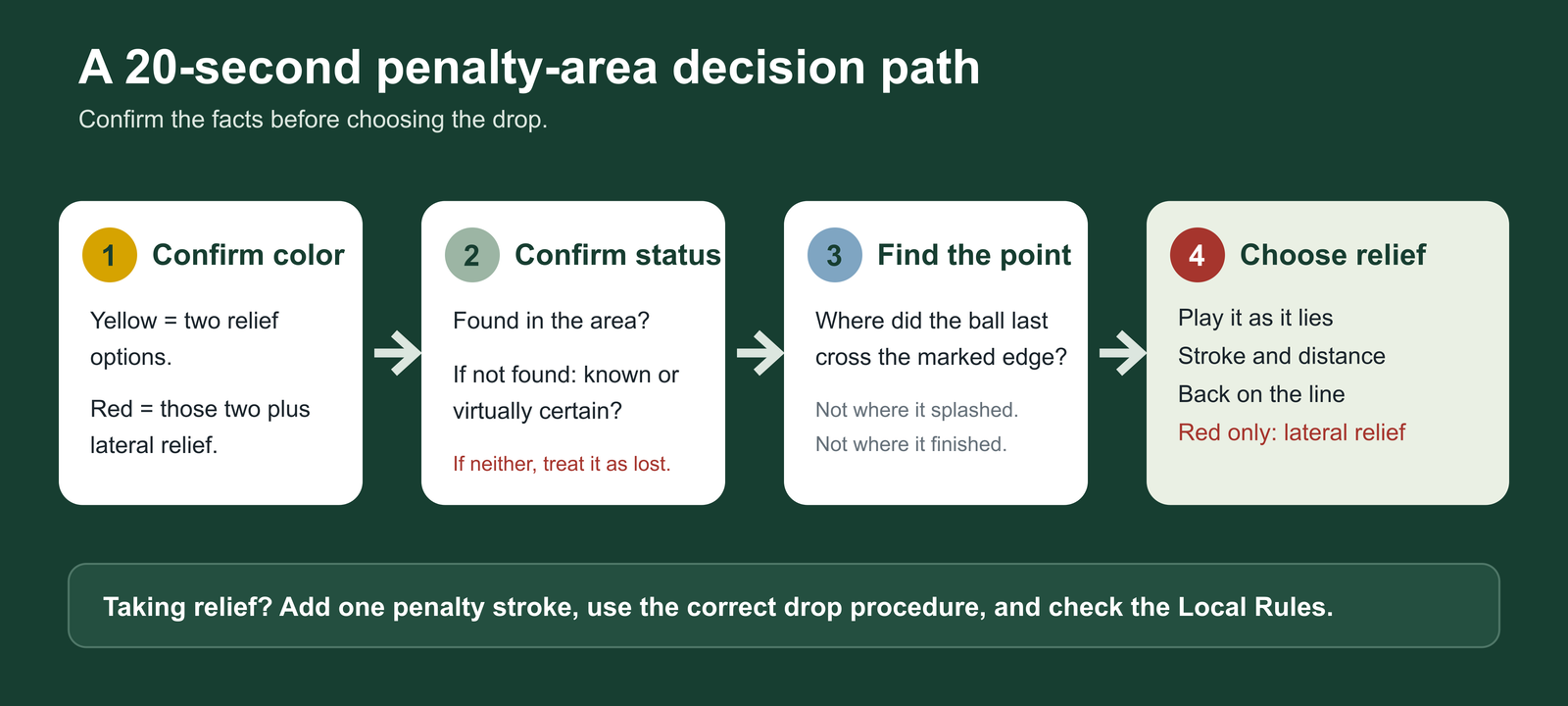
- Confirm the color: red or yellow.
- Decide whether the ball is found in the area or known or virtually certain to be there.
- Identify the point where the ball last crossed the edge.
- Choose: play it, stroke and distance, back on the line, or—for red only—lateral relief.
- Add one penalty stroke if taking relief and follow the correct dropping procedure.
- Check the Local Rules for a dropping zone or special penalty-area procedure.
Bottom line
Red and yellow do not describe different penalty amounts. They describe different relief menus. Both colors allow stroke-and-distance and back-on-the-line relief for one penalty stroke. Red adds lateral relief within two club-lengths of the last-crossing point.
If you remember only one sentence, remember this: yellow gives two one-stroke relief options; red gives those two plus lateral relief.
Sources and rules record
Primary governing-body sources checked August 31, 2026. This article uses the Rules of Golf and official USGA guidance rather than third-party rules summaries.
- USGA—Rule 17: Penalty Areas. Formal rule covering when a ball is in a penalty area, playing it as it lies, relief options, known-or-virtually-certain cases, and unavailable relief under other Rules.
- USGA Rules Topic—Penalty Areas. Official plain-language overview of the two yellow and three red relief options.
- USGA—Definition of Penalty Area. Definitions for red and yellow penalty areas, lines, stakes, and the vertical extent of the edge.
- USGA FAQ—Relief from a Red or Yellow Penalty Area. Official comparison of stroke and distance, back on the line, and red-only lateral relief.
- USGA—Key Changes to the Rules of Golf in 2023. Explanation of the revised back-on-the-line procedure.
- USGA—Model Local Rule B-2. Committee option for opposite-side relief at specified red penalty areas.
- USGA—Rule 18.3: Provisional Ball. When a provisional is allowed and how a possible loss outside a penalty area differs from a ball whose only possible location is the penalty area.
- USGA—Model Local Rule B-3. Committee option allowing a provisional ball for a specified penalty area.