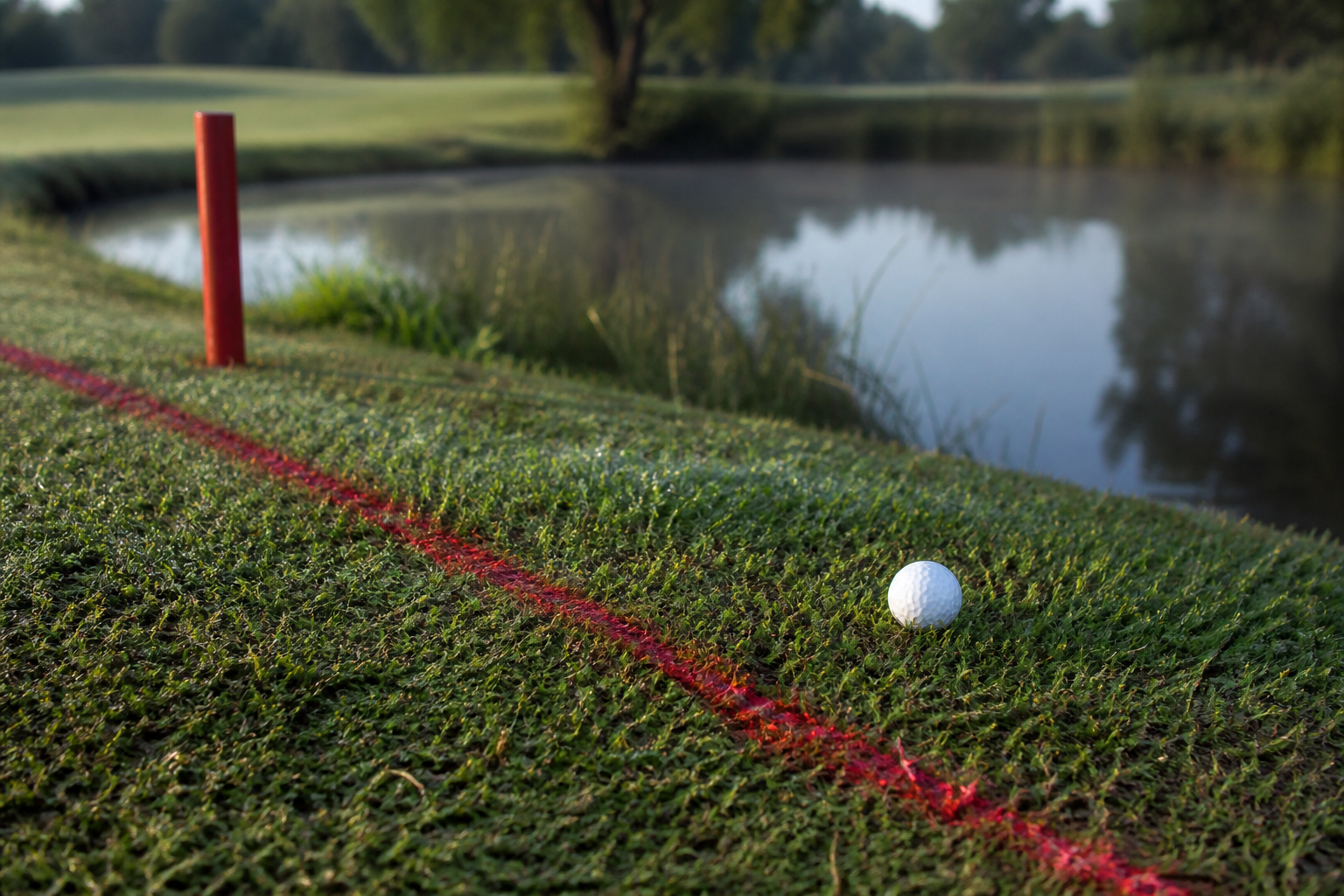
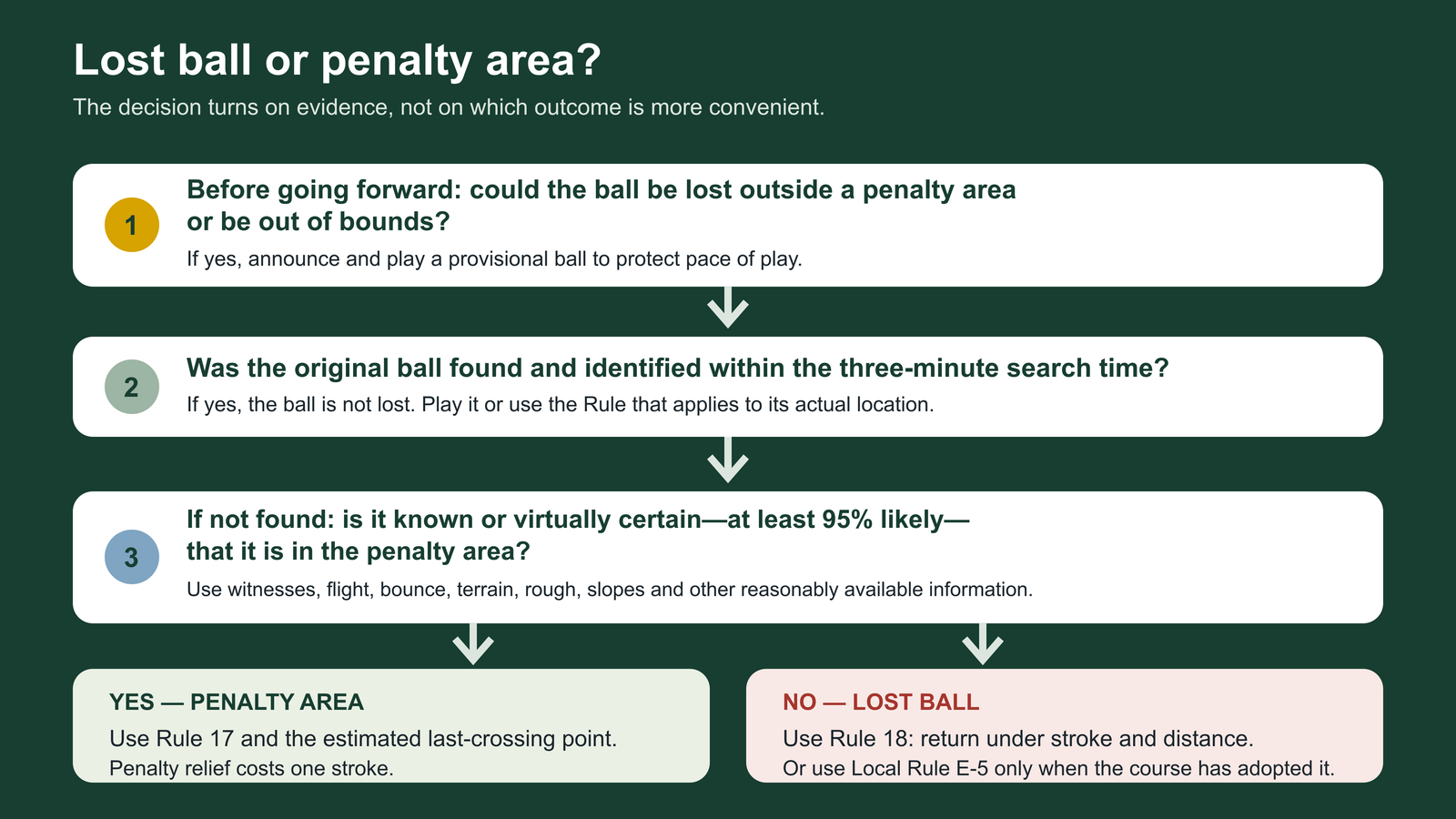
If your ball is found and identified within three minutes, it is not lost. If it is not found, ask whether it is known or virtually certain—at least 95% likely—that it came to rest in the penalty area.
If the answer is yes, use Rule 17 and the estimated point where the ball last crossed the edge. If the answer is no, the ball is lost outside a penalty area and Rule 18 normally requires stroke-and-distance relief from the previous spot.[1][2][3]
Why the distinction matters
Penalty-area relief and lost-ball relief can each add one penalty stroke, but they send you to different places. For a penalty area, your relief options are based on the previous spot or the estimated point where the ball last crossed the penalty-area edge. For a lost ball, the default result is stroke and distance: add one penalty stroke and play again from where the previous stroke was made.[1][2]
| Decision | Penalty area | Lost outside penalty area |
|---|---|---|
| Evidence needed | Found there, seen entering, or at least 95% likely | Not found within three minutes and the 95% standard is not met |
| Rule | Rule 17 | Rule 18 |
| Normal reference | Last-crossing point or previous spot | Previous spot |
| Default penalty | One stroke when taking relief | One stroke plus loss of distance |
The optional two-stroke Local Rule E-5 is discussed later; it is not the default Rule 18 procedure.
Tee shot into a penalty area: stroke 1, one penalty stroke, next stroke is 3. Tee shot lost in rough with stroke and distance: stroke 1, one penalty stroke, replay from the tee as stroke 3. The number is the same at that moment, but the lost ball also gives up all the distance gained by the original shot.
When is a ball officially lost?
A ball is lost when it is not found within three minutes after the player or the player's caddie begins to search for it. The Rule does not require you to search for the full three minutes; it gives you up to three minutes to find and identify the ball.[1]
If a ball is found during that time but you cannot immediately identify it, you are allowed a reasonable time to reach and identify it, even if the three minutes expires while you are doing so. If it is not identified within that reasonable time, it is lost.[1]
What may you do while searching?
You may take reasonable actions to find and identify the ball, including moving grass, bushes, branches, sand or water when reasonably necessary. If you, your opponent or anyone else accidentally moves the ball while trying to find or identify it, there is no penalty, but the ball must be replaced on its original spot, which may be estimated.[4]
Start a phone or watch timer when the player or caddie begins searching. Ask the group where the ball was last seen, then search likely stopping places—not only the place where it first disappeared from view.
The 95% test: known or virtually certain
The Rules use a demanding standard to decide what happened to a ball that has not been found. “Known or virtually certain” means either there is conclusive evidence, such as a player or witness seeing the ball enter the area, or all reasonably available information makes it at least 95% likely that the event occurred. Possible, probable or “it must be in there somewhere” is not enough.[3]
All reasonably available information includes what the player knows and what can be learned with reasonable effort and without unreasonable delay. For a ball near a penalty area, that may include:
- The ball's flight, curve, landing point and bounce.
- Whether anyone saw a splash or saw the ball cross the marked edge.
- The slope and firmness of the ground and whether they feed balls toward the area.
- The height and density of rough, bushes, trees or leaves outside the area.
- Other realistic places where the ball could have stopped.
- Statements from players, caddies, spectators or course staff who saw what happened.
Is there a realistic location outside the penalty area where the ball could be lost? If the answer is more than a very small possibility, the 95% standard may not be met.
The evidence is judged at the deadline
Whether the standard is met must be decided using the evidence known when the three-minute search time expires. Information discovered later does not retroactively change a ball that was already lost. The official interpretations give examples in which a ball found later in an animal hole, or later discovered to have been picked up by a spectator, remains lost because the necessary evidence was not known when the search time ended.[7]
There is an equally important commitment point on the penalty-area side. Once you put another ball in play to take Rule 17 relief because the original is known or virtually certain to be in the penalty area, the original ball is no longer in play—even if someone finds it before the three-minute search time would have expired.[2]
Four common on-course scenarios
1. Everyone sees the ball enter a red creek
The flight and entry are clearly observed, and there is no evidence that the ball came back out. It is known that the ball is in the penalty area. You may use Rule 17 even if the ball is not found. Estimate where it last crossed the red edge and choose an available relief option.[2]
2. The ball disappears where thick rough borders a pond
No one sees the ball cross the yellow line. The rough is deep enough to hide a ball, and the ball could reasonably have stopped outside the penalty area. It may be more likely than not that the ball reached the pond, but that does not automatically reach 95%. If the ball is not found within three minutes and the standard is not met, it is lost under Rule 18—not a penalty-area ball.[1][3]
3. A blind slope feeds directly into a marked area
No one sees the ball finish, but the flight, ground contour and short grass leave virtually no realistic stopping place outside the penalty area. The ball may be known or virtually certain to be in the area even without a visible splash. This is a judgment based on the full evidence, not a rule that every downhill shot near water qualifies.[3]
4. The original ball is found outside the area in time
The ball is identified in bounds within three minutes. It is not lost, even if it is buried in rough or unplayable. You must continue with that original ball and use the Rule that applies to its actual lie. You cannot choose a provisional ball merely because its position is better.[1][8]
Use a provisional ball before the uncertainty becomes expensive
If your original ball might be lost outside a penalty area or might be out of bounds, you may save time by playing a provisional ball before going forward to search. You must announce that you are playing a provisional before making the stroke; saying only “I am hitting another one” does not clearly establish provisional status.[1][8]
You may continue playing the provisional while it remains no nearer the hole than the estimated location of the original ball. If the original is lost outside a penalty area or out of bounds, the provisional becomes the ball in play under stroke and distance. If the original is found on the course within three minutes, or is found in or known or virtually certain to be in a penalty area, the ordinary provisional must be abandoned.[1][8]
If the only possible place the original ball could be lost is a penalty area, the normal provisional-ball Rule is not available. A Committee may adopt Model Local Rule B-3 for a particular penalty area, but that special procedure exists only when the Local Rule is actually in effect.[1][9]
What about the two-stroke fairway-side drop?
Model Local Rule E-5 lets a Committee offer an alternative to returning to the previous spot for a ball lost outside a penalty area or a ball out of bounds. When adopted, the player may estimate the ball reference point and a fairway reference point, then drop in a large relief area for two penalty strokes. The option is designed to improve pace of play in general play and is not intended for professional or elite amateur competition.[5][6]
E-5 is not a universal casual-golf rule. Confirm that the course has adopted it. It cannot be used when the ball is known or virtually certain to be in a penalty area, and it is generally unavailable for the original ball after a provisional has been played.[5][6]
Your tee shot is lost in rough and the Local Rule is in effect. Add two penalty strokes, drop in the defined relief area and play your fourth stroke. That result is designed to approximate returning to the tee, adding one penalty stroke and playing a third shot forward.
Six mistakes that change the result
The 30-second decision checklist
- Before going forward, decide whether a provisional is allowed and sensible.
- Start the three-minute clock when the player or caddie begins searching.
- Gather the ball-flight, witness, terrain and rough evidence.
- Ask whether it is at least 95% likely that the ball came to rest in the penalty area.
- If yes, use Rule 17 and the last-crossing point.
- If no and the ball is not found in time, use Rule 18 from the previous spot—or E-5 only if adopted.
Bottom line
A missing ball beside a penalty area creates an evidence decision before it creates a relief decision. The three-minute limit determines whether the ball has been found. The known-or-virtually-certain standard determines whether an unfound ball may be treated as being in the penalty area.
If the evidence reaches at least 95%, use Rule 17. If it does not, and the ball is not found in time, use Rule 18. When the landing area creates genuine uncertainty, the most useful decision often happens back at the previous spot: announce and play a provisional before walking forward.
Sources and rules record
Primary governing-body sources checked August 31, 2026. This article uses the Rules of Golf, official definitions, interpretations and Committee procedures rather than third-party rules summaries.
- USGA—Rule 18: Stroke and Distance; Ball Lost or Out of Bounds; Provisional Ball. Formal rule for the three-minute search, stroke-and-distance relief, and when a provisional ball is allowed, becomes the ball in play or must be abandoned.
- USGA—Rule 17: Penalty Areas. Formal rule allowing penalty-area relief when a ball is found there or known or virtually certain to be there, including the effect of putting another ball in play.
- USGA—Definition of Known or Virtually Certain. Defines the standard as conclusive evidence or at least 95% likelihood using all reasonably available information.
- USGA—Rule 7: Ball Search. Explains reasonable search actions, identification and the no-penalty replacement procedure when a ball is accidentally moved during search.
- USGA Rules Topic—Out of Bounds, Lost Ball and Provisional. Official plain-language overview of lost-ball procedure, provisional balls and the optional two-stroke Local Rule.
- USGA—Stroke and Distance. Explains Model Local Rule E-5 reference points, scoring and pace-of-play purpose.
- USGA—Known or Virtually Certain Interpretations. Explains that the evidence is judged when the three-minute search time expires and gives examples in which later information does not reverse a lost-ball result.
- USGA—Rule 18 Interpretations. Provides detailed provisional-ball outcomes, including announcement requirements and when a provisional becomes the ball in play or must be abandoned.
- USGA—Model Local Rules B-3 and E-5. Committee procedures for a provisional ball at a specified penalty area and the alternative to stroke and distance for a lost ball or out-of-bounds ball.