Weather really changes ball flight. Wind deserves particular attention; colder air can shorten shots too. But humid air is not heavier than dry air, and a grey sky is not a yardage measurement. Start by separating carry—the distance to first landing—from what happens after the bounce.
Headwinds take more than tailwinds give
A headwind increases airflow past the ball, raising drag and lift. The shot can climb and finish short. That ballooning does not mean the wind added spin at impact. A tailwind generally flattens the flight; it can add carry, but the shallower landing may also produce more release. [1]
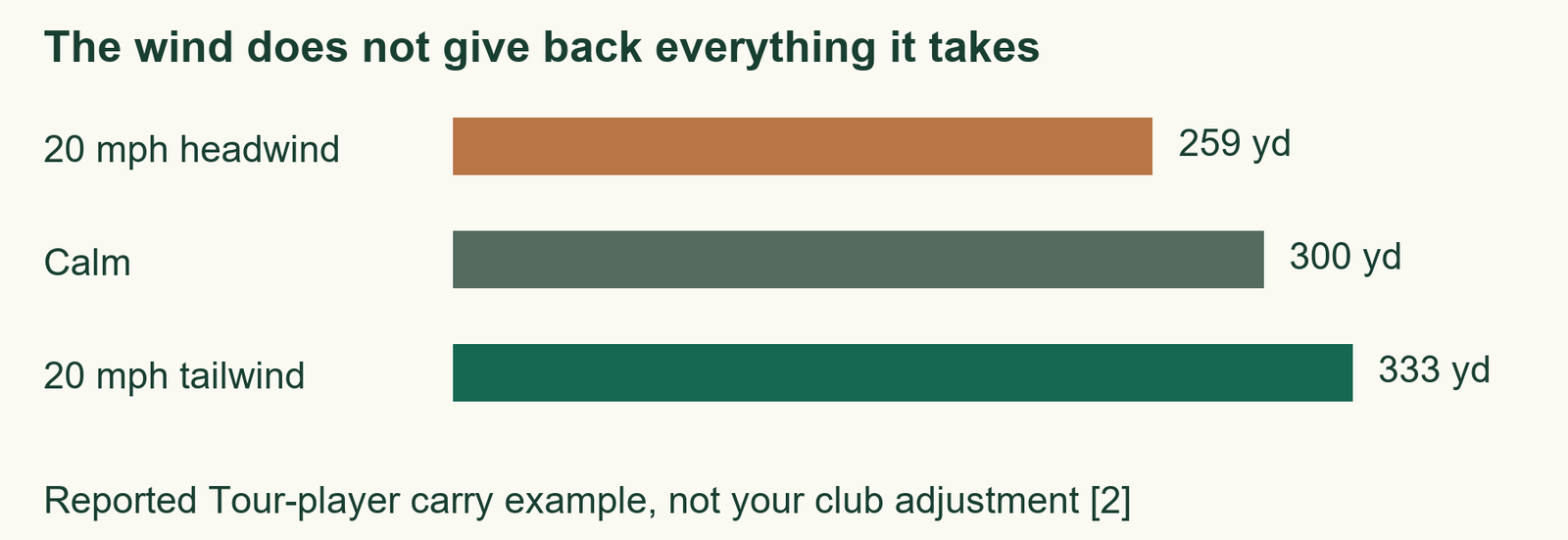
Coach Andrew Rice, describing his participation in Trackman research, reported this Tour-player driving example: 300 yards of carry in calm air, 259 into a 20 mph wind, and 333 with it. The loss was 41 yards; the gain only 33. That is a substantial wind, not an estimate of the breeze in our round. [2]
What to change on the course
Into a breeze, consider more club and a controlled swing rather than trying to overpower it. Downwind, leave room for release. There is no reliable “one yard per mph” rule for every club: launch, spin and the wind through the whole flight change the answer. [1]
Crosswinds change the target
A side wind can move a well-struck ball sideways. Your normal curvature still matters: a fade carried by a left-to-right wind can move farther right, while an opposing wind can reduce its visible curve. Wind drift is not automatically evidence of a bad swing. [3]
Our practical recommendation is to allow room on the upwind side of the target and favour a wider landing area. In gusts, aim away from trouble rather than trying to calculate an exact sideways correction. Watch exposed flags and treetops as well as the breeze where you stand; sheltered ground can be misleading. [1]
Cool air can cost a few yards
Titleist gives a rough distance loss of 1.5% for a 20°F temperature drop. Its example is about three yards on a 200-yard shot when the air cools from 70°F to 50°F. That illustrates the scale; it is not an automatic extra club for every cool morning. [4]
The ball’s own temperature is a separate issue. A cold ball can lose resiliency and leave the face slower. Store balls indoors at ordinary room temperature instead of leaving them in a cold car. A change in strike or swing speed can also muddy any comparison. [4]
And what about the golfer, not just the ball? If you feel stiff on a cold morning, an unready swing is another plausible suspect. A small study of 20 male golfers found improved clubhead speed in the group using a golf-specific warm-up. It did not compare cold and warm weather, so it cannot tell us whether stiffness costs more distance than cold air. Still, give yourself time to loosen up before blaming every missing yard on the forecast. [7]
Humid air is not heavy air
It sounds backwards because we picture water making things heavier. But humidity is invisible water vapour, not liquid droplets. At the same temperature and pressure, adding vapour replaces some of the heavier nitrogen and oxygen molecules in a given volume of air. Think of swapping heavier passengers for lighter ones while keeping the same number of seats occupied: the total weight falls. That makes humid air less dense, not more. [5]
This does not mean a muggy day guarantees longer drives. Temperature, pressure and wind also change, and clouds contain droplets or ice—not just vapour. The narrow point is that humidity alone is not a scientific explanation for “heavy” air holding the ball back. [5]
What high and low pressure look like
High-pressure systems often bring settled, fair weather; low-pressure systems more often accompany clouds, wind and rain. These are tendencies, not a way to diagnose pressure by looking up. Check the pressure or barometer reading in a weather app, usually shown in hPa, millibars or inches of mercury. At the same temperature and moisture level, higher pressure means denser air. So a clear day can have higher pressure than an overcast one—the sky’s colour is not the measurement. [5][8]
The sensible interpretation of that cloudy morning is uncertainty, not a special cloud penalty. It may have been cooler, the wind may have hurt particular shots, or the swing may have differed. Without measurements, we cannot choose among those explanations. The feeling was real; the cause was not established.
Do not confuse shorter flight with less roll
Damp, soft turf can take away the bounce and run you expect even when carry changes little. The USGA and R&A’s Distance Insights report found Tour driving distances about four yards shorter on rainy days. That is an association in overall driving distance, not proof that raindrops removed four yards in flight. [6]
The slope matters after landing
Landing into an upslope makes the arrival steeper relative to the turf, and gravity then helps slow the roll. A downslope offers a shallower meeting with the ground and encourages release. This is the slope where the ball lands, not an uphill or downhill stance. [9]
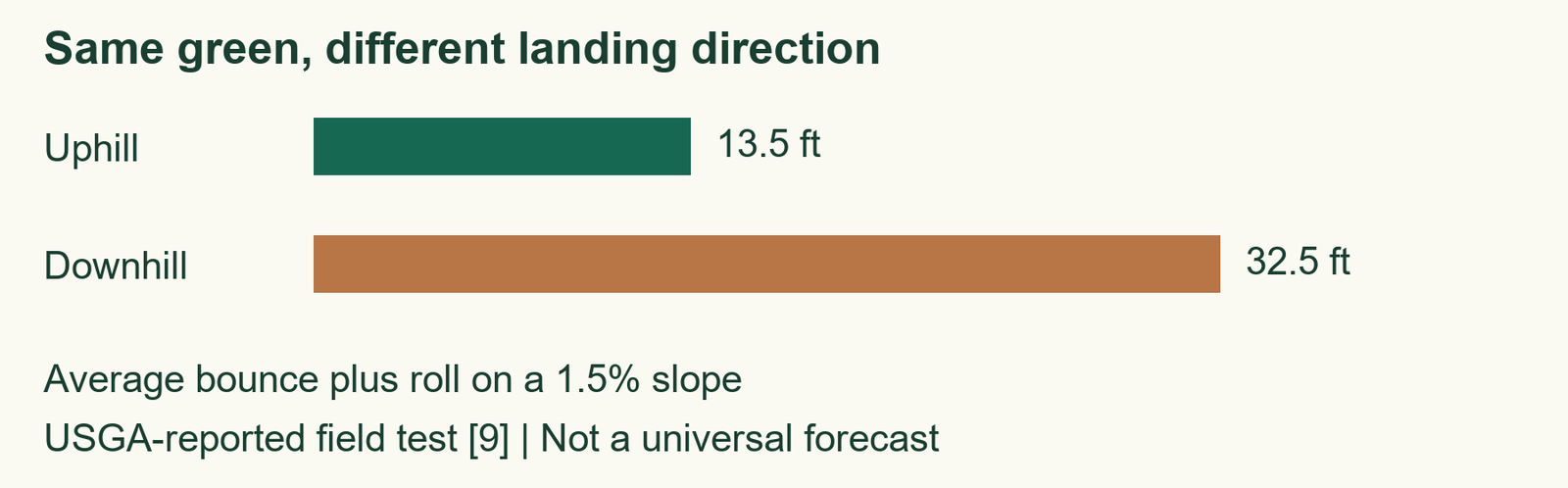
One useful example comes from a USGA-reported test at Paradise Valley Country Club in Arizona. Across 857 machine-fired shots on a nursery green with a 1.5% slope, average bounce plus roll was 13.5 feet uphill versus 32.5 feet downhill. Those are results from that test’s surfaces and shot conditions, not a correction to apply to every green. [9]
A simple check before choosing a club
First, judge the wind relative to this shot, including any headwind component in a diagonal breeze. Then compare the temperature with the conditions behind your usual yardages. Finally, decide how far the ball must carry and how much release the landing area allows, including its firmness and slope. A firm downslope calls for more landing room than a receptive upslope.
Use a few solid early shots to refine that judgment. Note whether they landed short or simply stopped sooner, and avoid rewriting the whole yardage chart after one mishit. These are practical checks, not a formula promising an exact correction.
The takeaway: give wind room in your plan, make modest temperature adjustments, and judge the ground separately. The clouds may look guilty, but they do not get an automatic conviction.
Sources and evidence notes
1 Trackman on normalization and wind ↗
Aerodynamic explanation of headwind, tailwind and landing angle. Its fixed-wind examples are not a universal club-selection rule.
2 Andrew Rice on weather and ball flight ↗
June 24, 2019. First-person report by a participant in Trackman research. Source of the 300, 259 and 333 yard example; the article does not supply a full dataset or reproducible trial protocol.
Distinguishes curvature established at impact from movement caused by wind. Supports the crosswind explanation, not a numerical drift calculator.
4 Titleist on temperature and golf balls ↗
Manufacturer explanation of air temperature and ball temperature. Labels the 1.5% per 20°F figure a rule of thumb.
5 National Weather Service hosted air density reference ↗
Physical relationships among temperature, pressure, moisture and density. The humidity comparison holds temperature and pressure equal.
6 USGA and R&A Distance Insights report ↗
2020 report, environmental and course-condition discussion. Rain-day driving distances were approximately four yards shorter; this is observational total distance, not isolated carry loss.
7 Fradkin and colleagues on a golf warm-up ↗
British Journal of Sports Medicine, 2004. Twenty male golfers, with ten in each group. Supports a possible warm-up contribution to clubhead speed, not a comparison of cold-weather stiffness against air-density effects.
8 National Weather Service on pressure ↗
Explains barometric measurements and the usual association of higher pressure with fair weather and lower pressure with unsettled weather.
9 USGA on stopping a ball on the green ↗
Brian Whitlark and Matt Pringle, November 30, 2012. Paradise Valley test: 857 shots, 1.5% slope, average bounce plus roll 13.5 feet uphill and 32.5 feet downhill. Specific field-test averages, not universal yardage adjustments.
Sources checked September 13, 2026. Practical advice is Golf Unpacked’s synthesis; reported examples are not guaranteed results.