If the battery is labeled in watt-hours (Wh), start there. If Wh is missing, calculate it from volts and amp-hours. Treat motor watts as power capability—not battery capacity or a shortcut to range.
A 299Wh pack nominally stores more energy than a 230Wh pack, but that does not mean the cart will travel exactly 30% farther. Range also depends on how efficiently the cart converts that energy into movement and how demanding the round is.
If the manufacturer shows volts and amp-hours instead of Wh, use Wh = V × Ah. If capacity is shown in milliamp-hours, divide by 1,000 first. For example, Axglo lists its e5 battery as 24V and 10,050mAh. That converts to 24 × 10.05 = 241.2Wh.
- Find the published Wh figure.
- If Wh is missing, calculate it from nominal V and Ah or mAh.
- Check that the battery belongs to the exact cart and model year.
- Read the conditions attached to any 18- or 36-hole claim.
- Treat motor wattage as context, not a shortcut to range.
What manufacturers actually display
There is no consistent golf-industry label. Some manufacturers publish Wh prominently, some require a calculation, and others emphasize a hole count while withholding the underlying capacity. That makes a source-first comparison more valuable than a simple ranking.
| Cart or battery | As displayed | Comparable Wh | What needs explaining |
|---|---|---|---|
| MGI Zip Navigator | 24V 299Wh | 299Wh published | Clean comparison value; the 36-hole claim is still conditional. |
| Stewart Q Follow | Base 230Wh / Max 307Wh | 230Wh or 307Wh published | The current product page also contains a conflicting 384Wh line, so the exact SKU must be confirmed. |
| Alphard V2/V2Pro | 192.4Wh max | 192.4Wh published | A separate 36V, 5,200mAh listing calculates to 187.2Wh. The two figures may use different rating conventions, so confirm the exact pack before comparing. |
| Axglo e5 | 24V, 10,050mAh | 241.2Wh derived | Wh is not foregrounded; current and older pages also show different motor ratings. |
| Motocaddy M7 GPS Remote | 28.8V, 11Ah | 316.8Wh derived | The battery page calls this the ULTRA pack but gives an 18-hole normal-condition claim. |
Specifications reflect the linked manufacturer pages at the time of research. Product details can change, so confirm the current listing before buying.
The MGI Zip Navigator example
MGI gives us a useful example because it publishes both kinds of number shoppers commonly confuse. The current Zip Navigator is sold with a 24V, 299Wh lithium battery and two 230W motors.
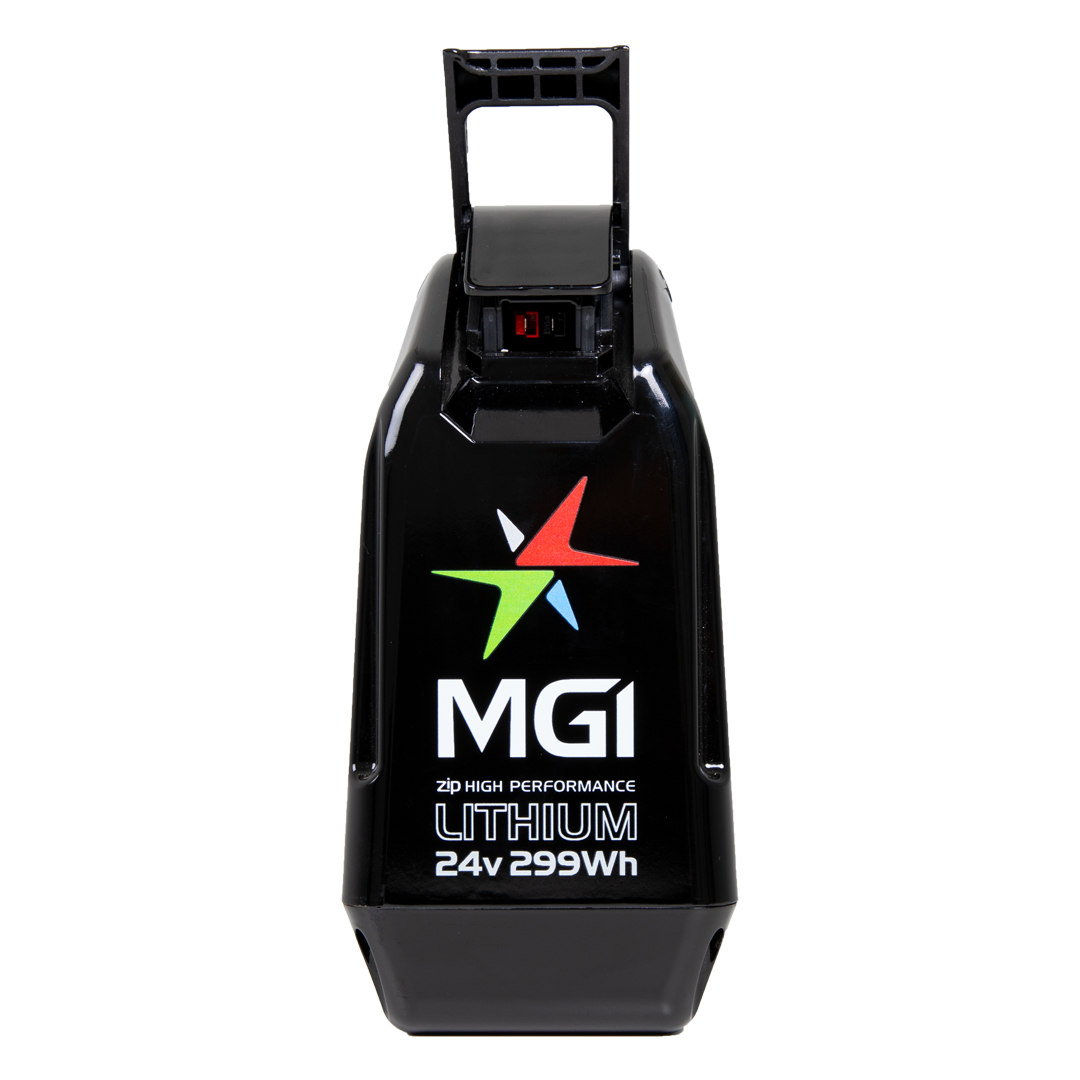
The capacity is printed directly on the pack, so no voltage-to-amp-hour conversion is needed.
Official product image and specifications: MGI Golf ↗The battery figure can be read directly. If someone wanted the approximate amp-hour equivalent, 299Wh divided by 24V is about 12.46Ah. That conversion does not make the battery larger or more informative; it simply expresses the same nominal capacity in another way.
The two 230W motors answer a different question: how much power the drive system can deliver at its rating. Adding them gives 460W of motor rating, but the motors do not draw 460W continuously during a round. A cart coasting on firm, level turf may need far less. Climbing, accelerating, correcting direction, or moving through wet grass can require more. Controller limits, motor efficiency, and operating speed also matter.
A purely hypothetical division—299Wh divided by 460W—produces about 0.65 hour. That is not a golf-course runtime prediction. It describes how long the nominal battery energy would correspond to a constant 460W electrical load before reserves and losses. The cart's real load is neither constant nor necessarily equal to the motors' published rating.
MGI's 299Wh figure describes battery capacity. The twin 230W ratings describe the drive system; they should not be turned directly into a mileage claim.
Why a “36-hole battery” is not a standard test
A hole is not a unit of distance or energy. One 18-hole route might be about five miles; another can be longer because of green-to-tee walks, routing, detours, and where carts are allowed. Elevation and ground condition can make two courses of similar length demand very different amounts of energy.
MGI qualifies its 36-hole statement by naming hilly or long courses, wet ground, heavy bags, battery age, battery care, and time between rounds. Axglo says its e5 can complete around 36 holes in normal conditions but does not guarantee it. Motocaddy says its M7 remote battery will complete 18 holes under normal conditions. These statements are useful descriptions of intended use, but they are not interchangeable laboratory results.
Stewart Golf provides an unusually useful reference point. Its service FAQ says a 14kg bag used an average of 135Wh per round across 600 rounds in varied weather and course conditions. That is a valuable per-round anchor, but the company does not publish the corresponding average route distance or elevation. Without those details, the figure cannot responsibly be converted into a universal Wh-per-mile number.
What changes energy use during a round
Battery capacity sets the energy budget. The course and cart determine how quickly that budget is spent.
- Moved mass. Range depends on the combined weight of the cart, golf bag, and accessories. The golfer's body weight is not part of the moved load because the golfer is walking, not riding.
- Climbing. Elevation gain requires additional energy, so a hilly course can shorten range even when its measured distance is similar to a flatter course.
- Ground resistance. Firm fairway turf and paved paths generally demand less than soft, wet, or thick ground. MGI explicitly identifies wet ground as a factor in its range qualification.
- Steering and control mode. Differential steering repeatedly drives the two wheels at different outputs. Stewart specifically advises that steering is a large source of consumption and that remote or follow use can be reduced to conserve energy.
- Starts, speed changes, and braking. Frequent acceleration costs more than steady movement. Downhill control also changes how the motors and controller behave.
- Battery health and temperature. Rechargeable batteries lose usable capacity as they age, and very hot or cold conditions can affect performance.
- Accessories. USB charging and powered screens draw from the main battery on some carts. The effect may be small relative to propulsion, but it is not zero.
What the current evidence can—and cannot—tell us
Independent use reports help show whether manufacturer claims are plausible, but they rarely provide enough context for a direct range comparison. A Plugged In Golf review says its testing supported Axglo's 36-hole claim, but it does not publish course mileage, elevation, carried load, temperature, or remaining energy. A GolfBlogger review of the Q Follow reports roughly 40% battery use over a 5.5-mile home-course round and similar use on more rugged courses, but the battery variant is not identified.
Owner reports add valuable long-term context, but they also mix cart generations, battery ages, climates, bags, and charging habits. Patterns such as reduced capacity with age or higher demand in wet conditions are useful; an isolated report is not a controlled measurement.
A reviewer or owner can establish that a product was used and describe what happened. Reports become more useful for range comparisons when they identify the exact battery, distance, elevation, load, conditions, and remaining charge.
Battery chemistry, cycle life, and the BMS
Chemistry can affect weight, voltage behavior, cycle life, and safety characteristics, but chemistry alone does not determine golf-course range. Motocaddy identifies its M7 battery as NCM lithium. Stewart identifies LiFePO4 for the Q Follow. Alphard identifies lithium-ion 18650 cells. These labels help explain design choices; they do not replace the Wh figure.
Cycle-life numbers require conditions. Stewart's page refers to more than 2,000 charge cycles for its SmartPower battery, while Alphard says its replacement battery retains at least 80% capacity after 300 full cycles. Those claims may use different test conditions, depths of discharge, and end-of-life definitions, so they should not be ranked without the underlying methodology.
The battery-management system, or BMS, protects the cells and controls charging and discharge limits. That means nominal Wh is not necessarily the energy available before the cart shuts down. A cautious range estimate therefore keeps a reserve instead of assuming every nominal watt-hour is usable.
Check compatibility before buying a replacement battery
A battery with the same voltage or Wh is not automatically interchangeable. Connector type, polarity, physical fit, charger profile, BMS communication, discharge capability, weather sealing, and manufacturer requirements all matter. MGI, for example, distinguishes between 250Wh and 299Wh packs and specifies which Zip models accept them. Always confirm the exact cart-and-battery pairing before ordering a replacement.
Travel is a separate issue. The FAA says lithium-ion batteries above 160Wh are generally forbidden as passenger baggage, with limited approval provisions applying only to the 101–160Wh range. The packs in this comparison are roughly 192–317Wh, so golfers should not assume they can fly with them as ordinary baggage. Always check the airline and current rules before travel.
Bottom line
Read the battery label before the motor headline. If Wh is published, use it. If only voltage and Ah or mAh are published, calculate Wh and label it as derived. Then treat hole-count claims as conditional shorthand and ask what the course, cart, load, ground, control mode, weather, and battery age will demand.
For the MGI Zip Navigator, the practical reading is therefore: 299Wh describes battery capacity; twin 230W motors describe the drive system; and “up to 36 holes” is a conditional manufacturer claim rather than a guaranteed outcome.
Sources and evidence notes
- MGI Zip Navigator product page
- MGI 24V 299Wh battery page
- MGI Zip X1 product page
- Stewart Golf Q Follow product page
- Stewart Golf servicing and battery-use FAQ
- Alphard Club Booster V2 manual
- Alphard V2/V2Pro replacement battery
- Axglo e5 product page
- Motocaddy M7 GPS Remote product page
- Motocaddy M-Series 28V Remote battery
- BATCADDY X3R product page
- Plugged In Golf Axglo e5 hands-on review
- GolfBlogger Stewart Q Follow hands-on review
- FAA battery watt-hour guidance