A cart path, sprinkler head, drain or irrigation control box is normally an obstruction because it is artificial. If it cannot be moved with reasonable effort and it physically interferes with your ball, intended stance or intended swing, Rule 16 will often give free relief—provided the ball is not in a penalty area and the object has not been defined as a boundary or integral object.[1][2]
A concrete wall, bridge or utility structure needs the same analysis. Its material does not decide the ruling. Ask what the Committee calls it, where the ball lies and what interference actually exists.
“It is man-made, so I get a free drop” is incomplete. Artificial objects can be ordinary obstructions, movable obstructions, boundary objects or integral objects. Only the applicable category and Rule determine the result.
The 20-second obstruction decision
- Artificial or natural? Natural features are not obstructions.
- Boundary or integral? Neither category gives obstruction relief.
- Movable or immovable? Remove a movable object under Rule 15; Rule 16 governs an immovable one.
- Where is the ball? There is no free Rule 16 relief when the ball lies in a penalty area.
- What interferes? Look for the ball, intended stance or intended swing; line-of-play relief is narrower.
- If relief is allowed, use the nearest point of complete relief—not the nicest lie.
First, classify the object
| Category | Everyday examples | Normal result |
|---|---|---|
| Movable obstruction | Loose rake, sign, waste container or another artificial object movable with reasonable effort and no damage | Move it. If the ball moves while the object is removed, replace the ball without penalty. |
| Immovable obstruction | Surfaced cart path, sprinkler head, drain, irrigation box, bench, building or fixed protective fence | Free relief may exist for physical interference, subject to the ball's location and Rule 16. |
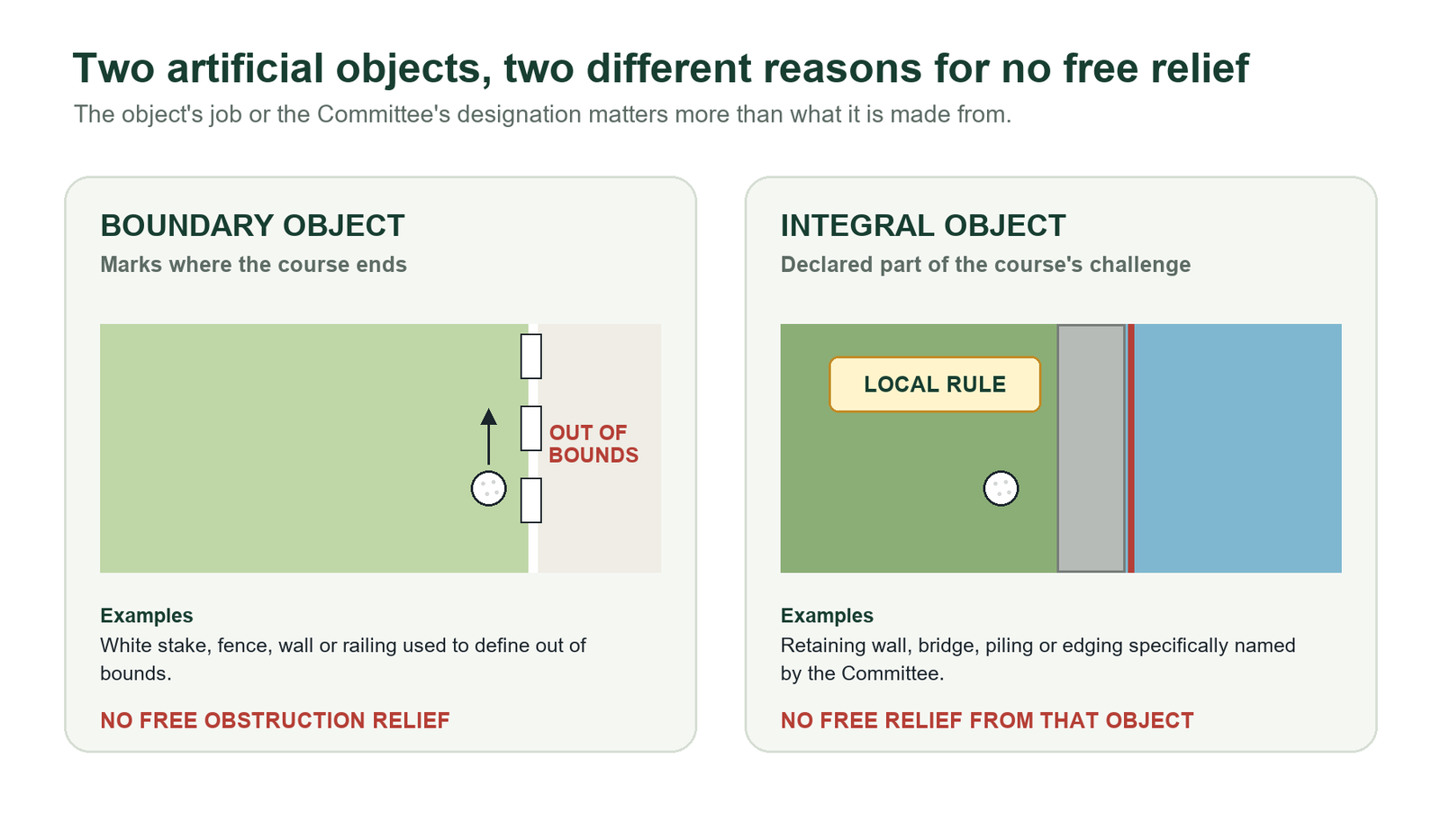
| Boundary object | White stake, out-of-bounds fence, wall or railing defining the course boundary | No free relief. Do not move it, even if it seems physically movable. |
| Integral object | Bridge, retaining wall, piling or another artificial feature the Committee has declared part of the challenge | No free relief from the object itself. |
The course's Local Rules are especially important for concrete retaining walls, bridge components, decorative stonework and structures within penalty areas. A Committee may define all or part of one of these features as an integral object.[1][7]
Boundary object and integral object, in plain English
A boundary object is an artificial marker whose job is to show where the course ends. Familiar examples are a white stake, out-of-bounds fence or boundary wall. Because the object defines out of bounds, the Rules deliberately exclude it from obstruction relief. If your ball is still in bounds but the fence or stake interferes, you do not get a free drop simply because the object is artificial. Play the ball as it lies or use another Rule that is available, such as unplayable-ball relief when the ball is outside a penalty area. If the ball is beyond the boundary, the out-of-bounds Rule applies.[1][4]
An integral object is different: it is an artificial feature the Committee has deliberately declared part of the course's challenge. A retaining wall, bridge, piling or decorative edging might be an ordinary obstruction at one course but an integral object at another. The physical appearance does not tell you which one it is; the Local Rules do. When the object is integral, there is no free relief from the object itself, although another Rule may still apply to the ball's situation.[1][7]
A white boundary stake is a boundary object and must not be moved. A red or yellow penalty-area stake is normally a movable obstruction and may usually be removed if it interferes, unless the Committee has declared it integral. The color signals a different job under the Rules.[1][3][4]
Movable does not mean “lightweight by design”
The test is practical: can the artificial object be moved with reasonable effort, without unduly delaying play and without causing damage? If yes, it is generally movable. You may remove a movable obstruction anywhere on or off the course, including in a bunker or penalty area. If the ball moves only because you removed the obstruction, there is no penalty; replace it.[3]
Boundary objects are different. A white stake or boundary fence is treated as immovable for the Rules even if a player could pull or lift it. Moving it to improve the stroke can bring a penalty.[1][4]
Second, decide whether there is interference
For an immovable obstruction, interference normally exists when the ball touches or lies in or on the object, or the object physically interferes with the area of your intended stance or intended swing.[2]
The obstruction does not have to touch your shoes or club before you act. You may make a reasonable judgment about the stance and swing you would use for the intended stroke. But you cannot manufacture relief by choosing a clearly unreasonable club, stance, swing or direction of play. There is also no relief if another condition—such as the ball being buried against a tree—makes the stroke clearly unreasonable even without the obstruction.[2][5]
A utility box that merely blocks your view, a cart path that distracts you, or a fixed object that lies somewhere along the flight of a shot does not create physical interference. Line of sight is not a relief condition.
Line of play near the green: the exception golfers overextend
If your ball is on the putting green, an immovable obstruction on or off the green also interferes when it is on your line of play. If your ball is off the putting green, line-of-play interference alone normally does not give free relief.[2]
Some courses adopt Model Local Rule F-5 for a sprinkler head or similar immovable obstruction close to the green and close to the ball. Under the current model wording, the obstruction must be on the line of play, on or within two club-lengths of the putting green and within two club-lengths of the ball. The course must actually adopt the Local Rule; it is not automatic.[8]
The penalty-area trap: locate the ball, not just the concrete
Rule 16 does not give free relief from an immovable obstruction when the ball lies in a penalty area. That remains true when the interfering object is a drain, bridge support, utility cabinet or concrete wall. The usual choices are to play the ball as it lies or take penalty-area relief under Rule 17.[2][6]
But an object can sit inside a penalty area while the ball lies outside it. If the object reaches across the marked edge and physically interferes with a ball, stance or swing in the general area, free relief can be available—unless the object is integral, a boundary object or out of bounds. The location of the object alone does not cancel relief.[6]
| Ball and structure | Likely ruling | Why |
|---|---|---|
| Ball outside penalty area; ordinary concrete wall interferes with swing | Free relief may be available | The ball is in the general area and there is physical interference from an immovable obstruction. |
| Ball inside penalty area; same wall interferes | No free Rule 16 relief | A ball in a penalty area is excluded from free relief for an immovable obstruction. |
| Ball outside; wall declared integral | No obstruction relief | An integral object is excluded from the definition of an obstruction. |
| Ball outside; wall defines out of bounds | No obstruction relief | A boundary object does not bring free relief. |
Find the red or yellow line or stakes, determine which side contains the ball, and read the Local Rules for the structure. Do not guess the penalty-area edge from the waterline or from where the concrete happens to sit.
Everyday examples
Surfaced cart path
An artificially surfaced road or path, including its artificial borders, is an immovable obstruction. If the ball is on the path or the path interferes with your intended stance or swing in the general area, you may play as it lies or take free relief. A worn dirt track is not automatically an obstruction, although a Committee may define a particular unsurfaced path as one.[1][7]
Sprinkler head
A fixed sprinkler head is an immovable obstruction. Physical interference brings the ordinary Rule 16 analysis. A sprinkler head between an off-green ball and the hole does not by itself provide relief unless it also interferes physically or the course has adopted Model Local Rule F-5. A sprinkler head that has popped up may be pushed back to its intended position.[1][8][9]
Drain or drain cover
A fixed drain is normally an immovable obstruction. If a removable cover has been displaced, the Rules allow it to be restored to its intended position. Then judge any remaining interference from the drain as it is meant to sit.[1][9]
Utility or irrigation control box
An irrigation or control box is specifically the kind of artificial object the obstruction definition covers. A fixed box usually qualifies as an immovable obstruction, so a ball resting against it or a box blocking the intended stance or swing may bring free relief. There is no relief merely because the box blocks the player's view of the hole or preferred shot window.[1][2]
Concrete retaining wall, piling or bridge near water
These are artificial, but their classification and the ball's location do the real work. The Committee may treat a retaining wall or piling in a penalty area as integral. If it has not, it may remain an obstruction—but a ball lying in the penalty area still gets no free Rule 16 relief. If the ball is outside the penalty area and the structure physically interferes, free relief may exist.[2][6][7]
Fence or structure around a green
A fixed protective fence is normally an immovable obstruction unless a Local Rule says otherwise. Physical interference with the ball, stance or swing can bring relief. If the ball is off the green and the fence only lies on the line of play, the ordinary Rule does not provide relief. Temporary structures used for competitions can be governed by additional Local Rules, so the event rules sheet controls.[2][7]
How to take free relief in the general area
For the most common case—a ball in the general area affected by an immovable obstruction—use this sequence:[2][5]
- Choose the stroke you would reasonably make if the obstruction were not there.
- Find the nearest point where the obstruction no longer interferes with the lie, intended stance or intended swing.
- That nearest point of complete relief must be in the general area and no nearer the hole than the original ball position.
- Measure one club-length from that reference point, using the longest club in your bag other than a putter.
- Drop the original ball or another ball in that relief area. It must come to rest in the relief area and there must be complete relief from the same obstruction.
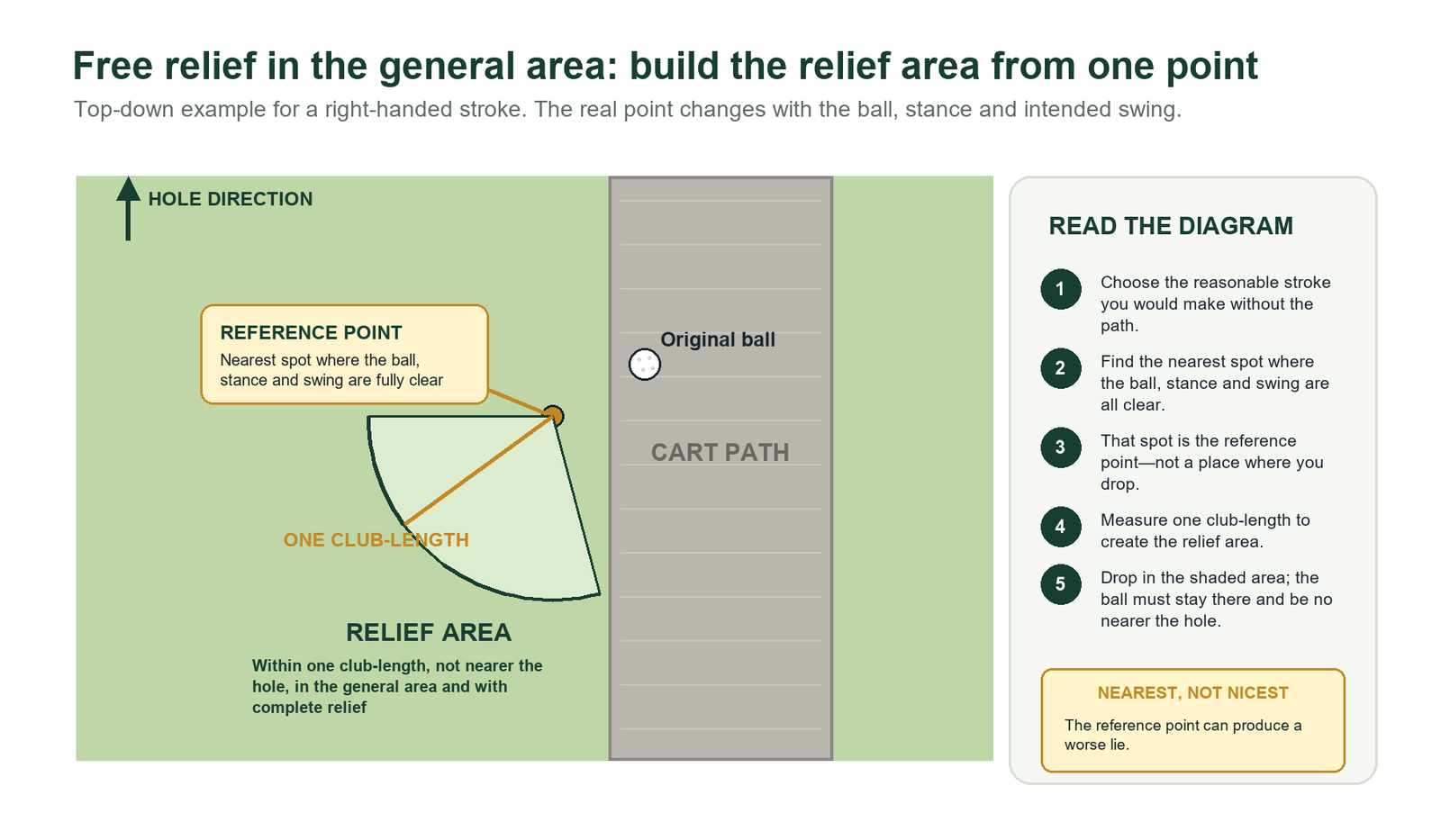
The nearest point of complete relief may be in rough, on a slope, behind a tree or even in a fairway. Better or worse is irrelevant. You cannot compare both sides of the obstruction and choose the one you prefer.[5]
What changes in a bunker or on the putting green?
In a bunker, free relief from an immovable obstruction must normally keep the ball in the bunker. If complete relief is unavailable, the Rule provides maximum available relief in the bunker; a player may also use the outside-the-bunker back-on-the-line option for one penalty stroke. On the putting green, the player lifts the ball and places it at the nearest point of complete relief rather than dropping it.[2]
Six debate-settling scenarios
1. Ball on grass, shoes would stand on the cart path
The ball does not need to lie on the path. If the intended stance is reasonable and the surfaced path physically interferes, free relief is available in the general area. Find the nearest point that clears both the ball and stance from the path.[2]
2. Utility box five yards ahead blocks a low shot
There is no physical interference with the ball, stance or swing. The box affects the desired line or trajectory, so ordinary Rule 16 relief is not available.
3. Ball outside a red line; bridge rail inside the area blocks the backswing
If the rail is an ordinary immovable obstruction and not integral, free relief may be available because the ball is in the general area and the structure physically interferes. Confirm the exact penalty-area edge and Local Rules first.[6]
4. Ball inside the red line beside the same rail
No free Rule 16 relief from the immovable obstruction. Play it as it lies if permitted, or take penalty-area relief under Rule 17.[2][6]
5. Concrete wall beside a pond is marked as integral
No obstruction relief, regardless of whether the ball is outside the penalty area. The player may need to play as it lies or use another applicable Rule, such as unplayable-ball relief when the ball is outside a penalty area.[1][7]
6. Sprinkler head is on the chip line but does not affect the stroke
No automatic relief when the ball is off the putting green. Check whether Model Local Rule F-5 is in effect and whether its distance conditions are satisfied. If not, play the ball as it lies or choose another legal stroke.[2][8]
The 30-second checklist
- Identify the artificial object and check whether it is movable.
- Look for white boundary markings and read the Local Rules for integral objects.
- Locate the ball relative to any red or yellow penalty-area edge.
- Confirm physical interference with the ball, intended stance or intended swing.
- For line-of-play claims, ask whether the ball is on the green or Local Rule F-5 applies.
- If free relief exists, use the nearest point of complete relief—not the best-looking option.
Bottom line
Cart paths, sprinkler heads, drains and utility boxes are usually ordinary obstructions. The harder cases—bridges, retaining walls, pilings, concrete structures and fences—are solved by the same disciplined sequence: classify the object, locate the ball, identify actual interference and then follow the relief procedure for that part of the course.
When the feature is close to water, never let the structure's location substitute for the ball's location. When it is close to a green, never treat a blocked line as automatic relief. And whenever a wall, bridge or decorative feature looks course-specific, the Local Rules are part of the answer—not fine print to consult after the argument.
Sources and rules record
Primary governing-body sources checked September 1, 2026. This article uses the Rules of Golf, official definitions, interpretations, clarifications and Committee procedures rather than third-party rules summaries.
- USGA—Definitions: Obstruction, Boundary Object, Integral Object and Nearest Point of Complete Relief. Defines artificial obstructions, excludes boundary and integral objects, lists common examples and explains the nearest point of complete relief.
- USGA—Rule 16: Relief from Abnormal Course Conditions. Governs interference and relief from immovable obstructions in the general area, bunker and putting green, and excludes balls lying in penalty areas.
- USGA—Rule 15: Relief from Loose Impediments and Movable Obstructions. Explains removal of movable obstructions, including what happens when the ball moves or lies in or on the object.
- USGA—Boundary Object FAQ. Confirms that an out-of-bounds wall, fence or stake provides no free relief and must not be moved.
- USGA—Rule 16 Interpretations. Explains reasonable strokes and why the nearest point of complete relief can produce a better or worse lie.
- USGA—Use the Rules to Your Advantage. Official example showing that an obstruction inside a penalty area may still bring relief when the ball lies outside the area and physical interference exists.
- USGA—Committee Procedures and Model Local Rules. Provides Local Rule language for integral objects, unsurfaced paths, protective fences and structures in or near penalty areas.
- USGA—Clarifications of the Rules of Golf and Model Local Rule F-5. Current clarification record, including the 2026 wording for optional line-of-play relief from immovable obstructions close to putting greens.
- USGA—Additional Clarifications of the 2023 Rules of Golf, updated April 8, 2026. Confirms that a popped-up sprinkler may be returned to its intended position and a displaced drain cover may be restored.